2026-04-29 マサチューセッツ工科大学(MIT)
<関連情報>
- https://news.mit.edu/2026/enabling-privacy-preserving-ai-training-everyday-devices-0429
- https://arxiv.org/abs/2510.03165
- https://arxiv.org/pdf/2510.03165
FTTE:連合型でリソース制約のあるディープエッジインテリジェンスの実現 FTTE: Enabling Federated and Resource-Constrained Deep Edge Intelligence
Irene Tenison, Anna Murphy, Charles Beauville, Lalana Kagal
arXiv last revised 23 Mar 2026 (this version, v2)
DOI:https://doi.org/10.48550/arXiv.2510.03165
Abstract
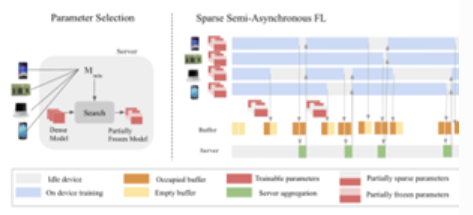
Federated learning (FL) enables collaborative model training across distributed devices while preserving data privacy, but deployment on resource-constrained edge nodes remains challenging due to limited memory, energy, and communication bandwidth. Traditional synchronous and asynchronous FL approaches further suffer from straggler induced delays and slow convergence in heterogeneous, large scale networks. We present FTTE (Federated Tiny Training Engine),a novel semi-asynchronous FL framework that uniquely employs sparse parameter updates and a staleness-weighted aggregation based on both age and variance of client updates. Extensive experiments across diverse models and data distributions – including up to 500 clients and 90% stragglers – demonstrate that FTTE not only achieves 81% faster convergence, 80% lower on-device memory usage, and 69% communication payload reduction than synchronous FL (this http URL), but also consistently reaches comparable or higher target accuracy than semi-asynchronous (this http URL) in challenging regimes. These results establish FTTE as the first practical and scalable solution for real-world FL deployments on heterogeneous and predominantly resource-constrained edge devices.