2026-04-17 中国科学院(CAS)
<関連情報>
- https://english.cas.cn/newsroom/research-news/202604/t20260420_1157556.shtml
- https://agupubs.onlinelibrary.wiley.com/doi/10.1029/2025GL119444
塩分濃度を介したインド太平洋盆地間結合によるENSO予測精度の休止期後向上 Post-Hiatus Enhancement of ENSO Forecast Skill via Salinity-Mediated Indo-Pacific Inter-Basin Coupling
Jing Wang, Janet Sprintall, Haoyu Wang, Xiaofeng Li
Geophysical Research Letters Published: 08 April 2026
DOI:https://doi.org/10.1029/2025GL119444
Abstract
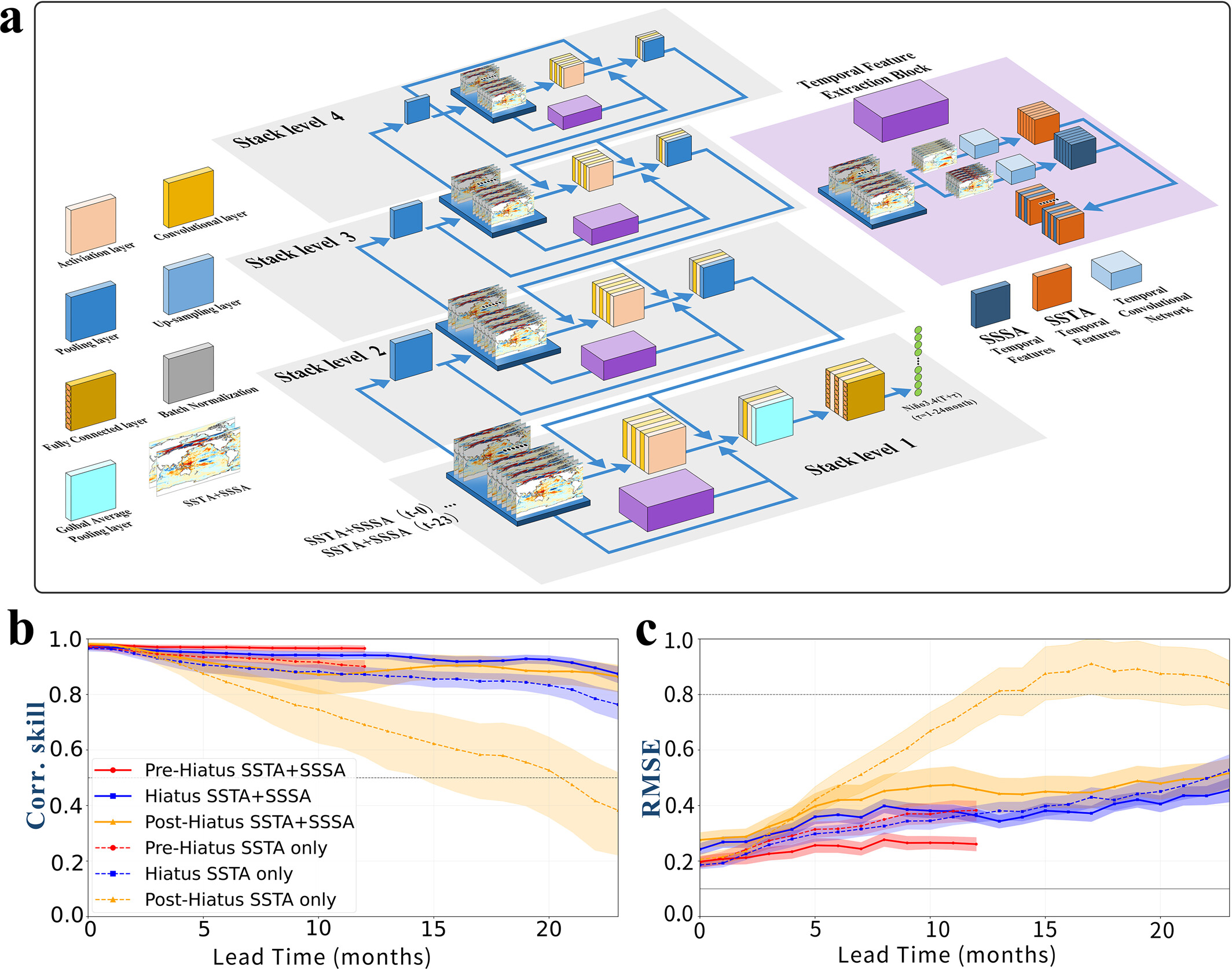
The El Niño–Southern Oscillation (ENSO) predictability has notably declined since the 1998–2013 global warming hiatus, challenging conventional sea surface temperature (SST)-based forecast models. We identify sea surface salinity (SSS) as a critical yet underappreciated driver for restoring ENSO forecast skill post-hiatus. Through an interpretable deep learning framework (STPNet), we show that incorporating SSS sustains forecast skill above 0.8 beyond 20-month leads, outperforming SST-only predictions after 2014. Attribution analysis reveals that Indo-Pacific SSS anomalies promote interbasin heat redistribution and preserve ocean memory critical for ENSO evolution. The Indonesian Throughflow functions as a salinity-sensitive conduit, where salinity-mediated geostrophic transport compensates for thermally induced weakening, sustaining Indo-Pacific connectivity. These findings reveal a new thermohaline pathway influencing ENSO forecasts and show that explainable AI can boost long-lead forecast skill while uncovering key ocean–climate interactions, offering a salinity-informed strategy to improve future predictions under climate change.
Plain Language Summary
The El Niño-Southern Oscillation (ENSO) strongly influences weather and climate around the world, but our ability to predict it has declined since the early 2000s. In this study, we find that changes in ocean salinity have become increasingly important for predicting ENSO in the recent warming period after the global warming hiatus. Using a new deep learning model, we show that including salinity information greatly improves ENSO forecast skill, especially at long lead times when temperature-only forecasts fail. We further identify the Indonesian Throughflow (ITF) as a key ocean “bridge.” Salinity changes help maintain the ITF between the Pacific and Indian Oceans, offsetting the weakening caused by temperature changes and preserving the ocean memory needed for ENSO to develop. These results reveal a new way that salinity connects the oceans and highlight its potential to improve future climate forecasts.