2026-04-13 中央大学
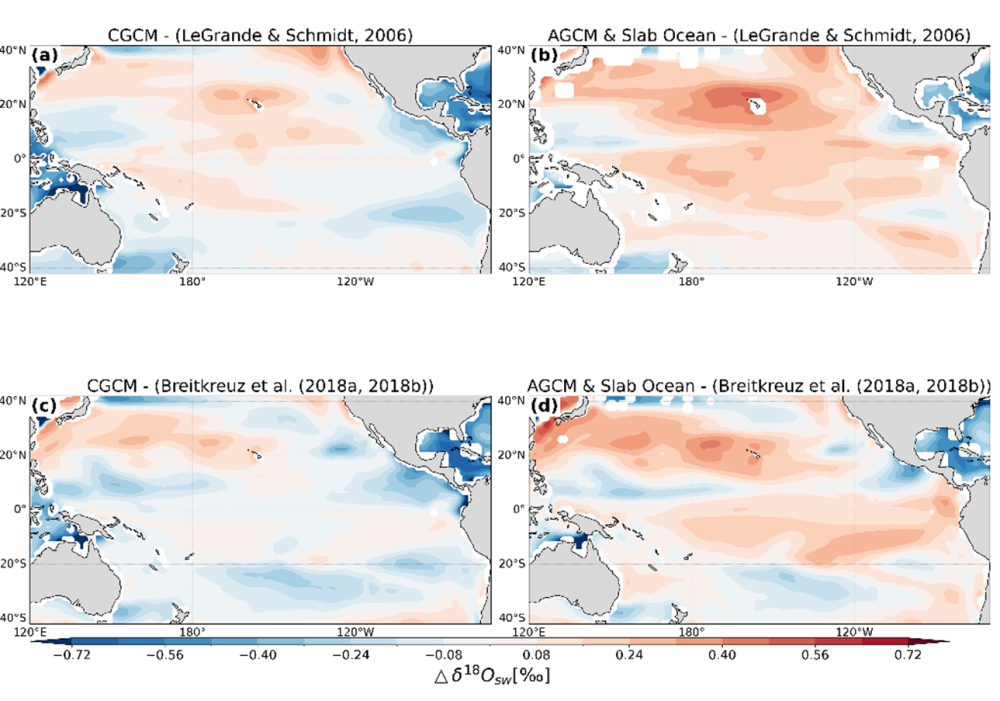
図1:太平洋におけるδ18Oswのモデル再現性比較。(a,c;左の2つの図)新しい大気・陸・海洋・海氷を結合した水同位体気候モデル(MIROC-iso)と準観測データとの差。(b,d;右の2つの図)従来型の表層における鉛直混合のみを考慮したモデルと準観測データとの差。赤や青が薄いほうが、誤差が小さいことを示すため、新しい大気海洋結合モデルにより高い再現性が得られたことを表す。
<関連情報>
- https://www.chuo-u.ac.jp/aboutus/communication/press/2026/04/85323/
- https://agupubs.onlinelibrary.wiley.com/doi/10.1029/2025MS005082
同位体対応完全結合モデルMIROC6-Isoを用いた太平洋におけるδ18Oswの大気海洋相互作用およびENSOに対する応答の改善 Improved Response of δ18Osw in the Pacific Ocean to Atmosphere-ocean Interaction and ENSO Using the Isotope-Enabled Fully Coupled Model MIROC6-Iso
Yifan Li, Alexandre Cauquoin, Atsushi Okazaki, Kei Yoshimura
Journal of Advances in Modeling Earth Systems Published: 07 April 2026
DOI:https://doi.org/10.1029/2025MS005082Digital Object Identifier (DOI)
Abstract
Stable water isotopes serve as tracers of climate processes and are useful for identifying drivers of regional and global hydrological variability. To get a precise picture of spatiotemporal changes in the water cycle, it is necessary to describe the mechanisms in a coherent way among the involved climatic reservoirs (atmosphere, land, and ocean). For example, in the Pacific Ocean, the oxygen isotopic composition (denoted δ18O) of surface seawater recorded in corals is widely used to reconstruct the El Niño–Southern Oscillation (ENSO). However, the influences of atmosphere–ocean feedback and ocean circulation on the δ18O–ENSO relationship are not fully understood. Describing water isotopes in the full climate system is one way to tackle this issue. Therefore, this study introduces the fully coupled isotopic version of the Model for Interdisciplinary Research on Climate version 6 (MIROC6-iso). MIROC6-iso exhibits good performance in reproducing spatial isotopic variations in precipitation, water vapor, and ocean water, and the relationships of δ18O with temperature and salinity against observations. We also find that the atmosphere-ocean Coupled General Circulation Model (CGCM) captures δ18Osw (seawater) variations significantly better than a configuration where an Atmospheric General Circulation Model is coupled to a 1D slab ocean model in Pacific Ocean in climatological condition and different ENSO phases. Budget analysis indicates that the better performance of the CGCM configuration is due to fully resolved oceanic vertical mixing and horizontal advection. This study shows that MIROC6-iso is useful to reconstruct past climate changes and examine the recent changes in the water cycle.
Plain Language Summary
The elements that make up water can have slightly different masses called isotopes, which help us understand changes in the Earth’s climate. These heavier and lighter water isotopes help us understand how water moves in cycles from the ocean to the atmosphere and then as rain and snow fall. Natural records contain these water isotopes and allow scientists to better understand past climates. For instance, oxygen isotopes in corals reveal insights into Pacific El Niño events. To better understand how water isotopes change from the ocean to the atmosphere to rain and snow, we developed a climate model capable of simulating water isotopes and how changes in the water cycle, named MIROC6-iso. We evaluated that MIROC6-iso shows good performance in simulating those isotopes. Moreover, we showed that compared with a one-dimensional ocean model coupled to the atmosphere-only simulation, the coupling between the atmosphere and the ocean allows for better capture of the seawater isotopic variations in the Pacific Ocean, which can be used to better describe El Niño events. Overall, MIROC6-iso represents an advanced tool for reconstructing historical climate patterns and enhancing our understanding of current and future changes of the Earth’s water cycle and climate.