2026-10-28 北海道大学,Quantum Nexus株式会社
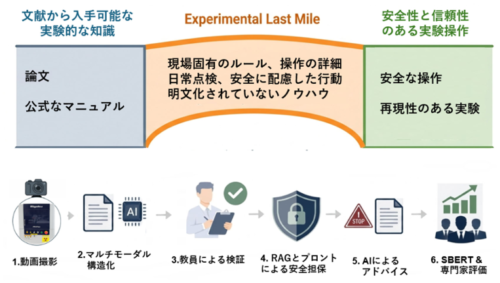
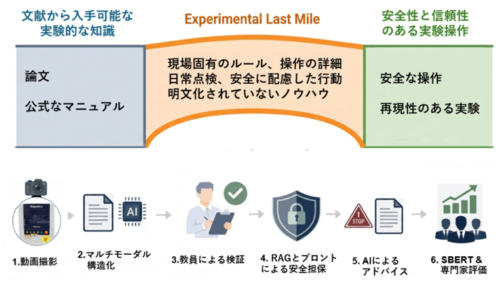
図1. 実験のラストマイルの概念と、⼈間介在型AI⽀援の流れ。
<関連情報>
- https://www.hokudai.ac.jp/news/2026/10/aiai-1.html
- https://www.hokudai.ac.jp/news/pdf/261028_pr2.pdf
- https://pubs.rsc.org/dd/article/doi/10.1039/D6DD00505E/1370945/Bridging-the-Experimental-Last-Mile-Digitizing
実験のラストマイルを埋める:安全拒否を備えたAI支援に向けた研究室ノウハウのデジタル化
Bridging the Experimental Last Mile: Digitizing Laboratory Know-How for AI-Assisted Support with Safe Refusal
Akira Miura; Momoka Demura; Tetsuya Asai; Yuki Sasahara; Yuji Masubuchi; Chikahiko Mitsui
Digital Discovery Published: 17 October 2026
DOI:https://doi.org/10.1039/D6DD00505E
While advances in materials informatics have accelerated the development of Self-Driving Laboratories (SDLs), human-led experiments remain standard in many educational and exploratory research settings. We refer to the gap between formal documentation and reliable execution in such settings as the experimental last mile; in the present powder X-ray diffraction (XRD) context, this gap mainly involves site-specific operational know-how, including local rules, routine checks, operational details, and safety-conscious actions that can be verbalized but are often underdocumented in standard manuals. In this proof-of-concept study, we propose an AI-assisted human-in-the-loop framework that utilizes first-person experimental video, multimodal models, and retrieval-augmented generation (RAG) to structure site-specific laboratory procedures. Using powder X-ray diffraction experiments and student-recorded video data as inputs, the system extracts site-specific laboratory knowledge from recorded procedures, including physical techniques and audible confirmation that conventional manuals could omit. It then provides grounded responses based on the resulting manual. To reduce the risk of unsupported outputs, the system employs a two-layer safety design: source restriction through RAG and strict system-prompt constraints. Instructor-based evaluation showed alignment with expected guidance for questions covered by the manual. For out-of-scope queries, the system appropriately refused to answer and referred students to instructors, substantially reducing the risk of hallucination and ensuring a ‘design success’ that prioritizes safety. Expert evaluation further indicated that the generated advisory reports were useful and safe (Usefulness: 3.50/4, Completeness: 3.75/4, Safety: 4.00/4). These results suggest a framework for bridging the experimental last mile in which AI supports laboratory practice under explicit human supervision rather than replacing human judgment.1.