2026-10-27 パシフィック・ノースウェスト国立研究所(PNNL)
米国のパシフィック・ノースウェスト国立研究所(PNNL)の研究チームは、次世代原子炉の過酷な環境に耐える新しい合金を、計算科学を活用して体系的に設計する手法「ロバスト合金設計(RAD)」を開発した。原子炉材料には、高温、放射線照射、機械的応力などに耐える強度と耐久性が求められる。従来のように既存合金の元素を部分的に置き換えるのではなく、元素の組み合わせを基礎から探索し、複数の要求性能を同時に満たす候補を絞り込む点が特徴である。研究チームは、計算による初期スクリーニングで724種類の有望な合金組成を抽出し、評価を経て候補合金「V555」を選定した。実際に合金を試作し、構造と機械的性質を評価したところ、室温での降伏強度は約500~600 MPaと推定された。今後は高温環境や放射線照射下での性能を検証する予定である。本手法は、先進原子炉に適した材料の探索を効率化し、次世代の核エネルギー技術を支える材料開発の加速につながると期待される。
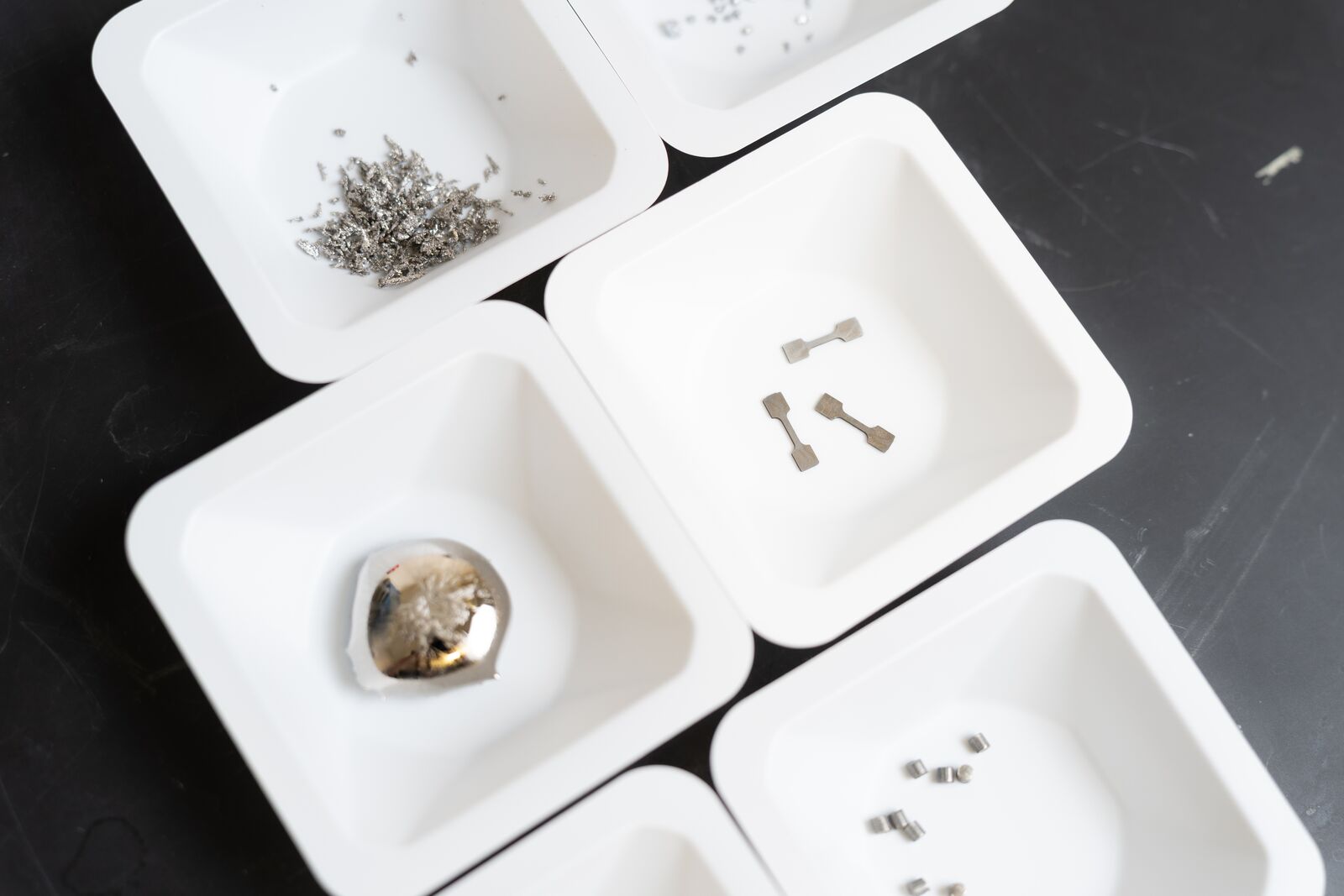
Samples of materials used to create new alloys by Pacific Northwest National Laboratory scientists: titanium (top left), chromium (top right), a V555 medallion and V555 tensile specimens (middle), and zirconium (bottom right). (Photo by Eddie Pablo | Pacific Northwest National Laboratory)
<関連情報>
- https://www.pnnl.gov/news-media/periodic-table-new-nuclear-energy-materials
- https://www.sciencedirect.com/science/article/pii/S026412752600585X
次世代(IV)核分裂炉のための堅牢な合金設計(RAD)戦略 A robust alloy design (RAD) strategy for next-generation (IV) nuclear fission reactors
M.S.K.K.Y. Nartu,S. Tripathi,I.K. Robin,S. Supakul, O. El-Atwani
Matrials & Design Available online: 13 April 2026
DOI:https://doi.org/10.1016/j.matdes.2026.116012
Highlights
- The Robust Alloy Design (RAD) strategy integrates nuclear criteria with high‑throughput thermodynamic analysis.
- The RAD strategy introduces a unified score combining FCCI, neutron absorption, VEC, and melting‑point metrics.
- The RAD framework enables alloy design with stable microstructures tailored to diverse reactor temperatures.
- The RAD approach identifies V555 as a top candidate with validated single‑phase structure and strong mechanical performance.
- The RAD framework is scalable to other extreme environments through customizable weighting of performance metrics.
Abstract
Next-generation nuclear reactors demand structural materials capable of withstanding extreme conditions, including high temperatures, intense neutron flux, and corrosive environments. Multi-Principal Element Alloys (MPEAs) have emerged as promising candidates due to their exceptional radiation tolerance, thermal stability, and compositional flexibility. This study introduces a versatile and customizable Robust Alloy Design (RAD) strategy for systematically designing MPEAs for GEN-IV reactor fuel cladding. The RAD framework integrates nuclear-relevant selection criteria, empirical parameter assessments, and high-throughput CALPHAD simulations to efficiently narrow compositional space and identify stable alloys. A unified RAD score developed for the first time, combines key performance metrics, including fuel-clad chemical interaction (FCCI), neutron absorption cross-section (NAC), valence electron configuration (VEC), and melting point factor (MPF), into a flexible ranking system adaptable to reactor-specific priorities. Among 724 candidates, V555(5Al–5Cr–5Fe–85V) emerged as the top alloy, validated experimentally with a homogeneous single-phase BCC microstructure and superior mechanical properties (nano-indentation: 3.389 ± 0.258 GPa; Vickers hardness: 240 ± 6.7 HV), significantly outperforming Zircaloy-4 and V-4Cr-4Ti. Importantly, the RAD strategy is not limited to nuclear applications; its customizable weighting system enables scalability to other extreme environments. This adaptability positions RAD strategy as a versatile tool for advanced materials design across multiple industries.