2026-10-15 中国科学院(CAS)
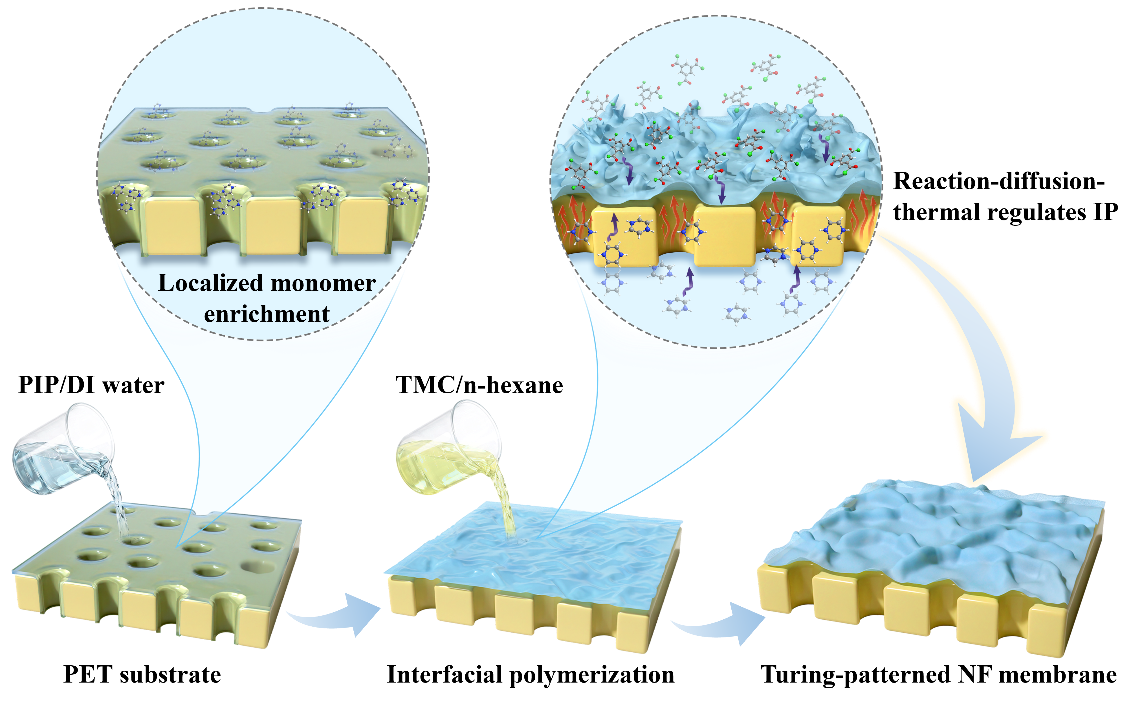
Schematic of the nanopore-mediated reaction-diffusion-thermal coupling strategy for fabricating Turing-patterned polyamide nanofiltration membranes. (Image from IMP)
<関連情報>
- https://english.cas.cn/newsroom/research-news/202610/t20261015_1203394.shtml
- https://www.sciencedirect.com/science/article/abs/pii/S1385894726100114
ナノポアを介した反応・拡散・熱結合により、有機微量汚染物質除去のためのチューリングパターン型ナノろ過膜が実現 Nanopore-mediated reaction–diffusion–thermal coupling enables Turing-patterned nanofiltration membranes for organic micropollutant removal
Mengling Fang, Xuanlin Li, Xin Huang, Jiao Tang, Qizhong Zhang, Xuanxuan Wu, Xiuwen Yang, Haizhou Xue, Jing Bai, Jinglai Duan, Jie Liu, Huijun Yao
Chemical Engineering Journal Available online: 29 September 2026
DOI:https://doi.org/10.1016/j.cej.2026.182548
Highlights
- A locally enhanced interfacial polymerization strategy exploits coupled monomer diffusion and thermal transport to induce spontaneous Turing pattern formation, identifying thermal transport as an intrinsic long-range regulator of reaction-diffusion instability.
- A thermally coupled reaction-diffusion framework reveals that diffusion contrast governs Turing pattern morphology, whereas the absolute rates of coupled mass and thermal transport determine characteristic feature size.
- The resulting Turing-patterned polyamide membranes mitigate the permeability-selectivity trade-off, achieving a water permeance of 9.11 L m−2 h−1 bar−1 together with 99.67% Na2SO4 rejection, efficient organic micropollutant removal, and favorable antifouling stability.
Abstract
Conventional polyamide nanofiltration (PA-NF) membranes fabricated by interfacial polymerization (IP) generally develop disordered nodular morphologies because of diffusion-limited reaction kinetics, resulting in an inherent permeability-selectivity trade-off. Here, a thermally coupled, nanopore-mediated IP strategy enables the controllable fabrication of Turing-patterned PA nanofiltration membranes. By integrating the intrinsically exothermic nature of IP with the discrete nanopores of ion-track-etched PET substrates, interfacial monomer availability and spatially non-uniform heat transport are coupled during membrane formation. The resulting concentration–thermal transport coupling is theoretically described within a Turing-type framework, generating ridge-valley architectures with tunable characteristic feature sizes. A thermally coupled reaction-diffusion (TCRD) model derived from the classical activator-substrate framework, together with numerical simulations, reveals that diffusion contrast governs pattern morphology, whereas the absolute rates of mass and thermal transport determine characteristic feature size. Regulating substrate pore size, monomer concentration, and reaction time enables precise control over membrane architecture. The optimized membrane exhibits a highly crosslinked, negatively charged selective layer with an effective molecular-sieving cut-off of 320 Da, achieving a water permeance of 9.11 L m−2 h−1 bar−1, 99.67% Na2SO4 rejection, efficient organic micropollutant removal, and favorable antifouling performance. This work establishes a TCRD framework for engineering self-organized interfacial architectures through coupled mass and thermal transport.