2026-10-06 東北大学
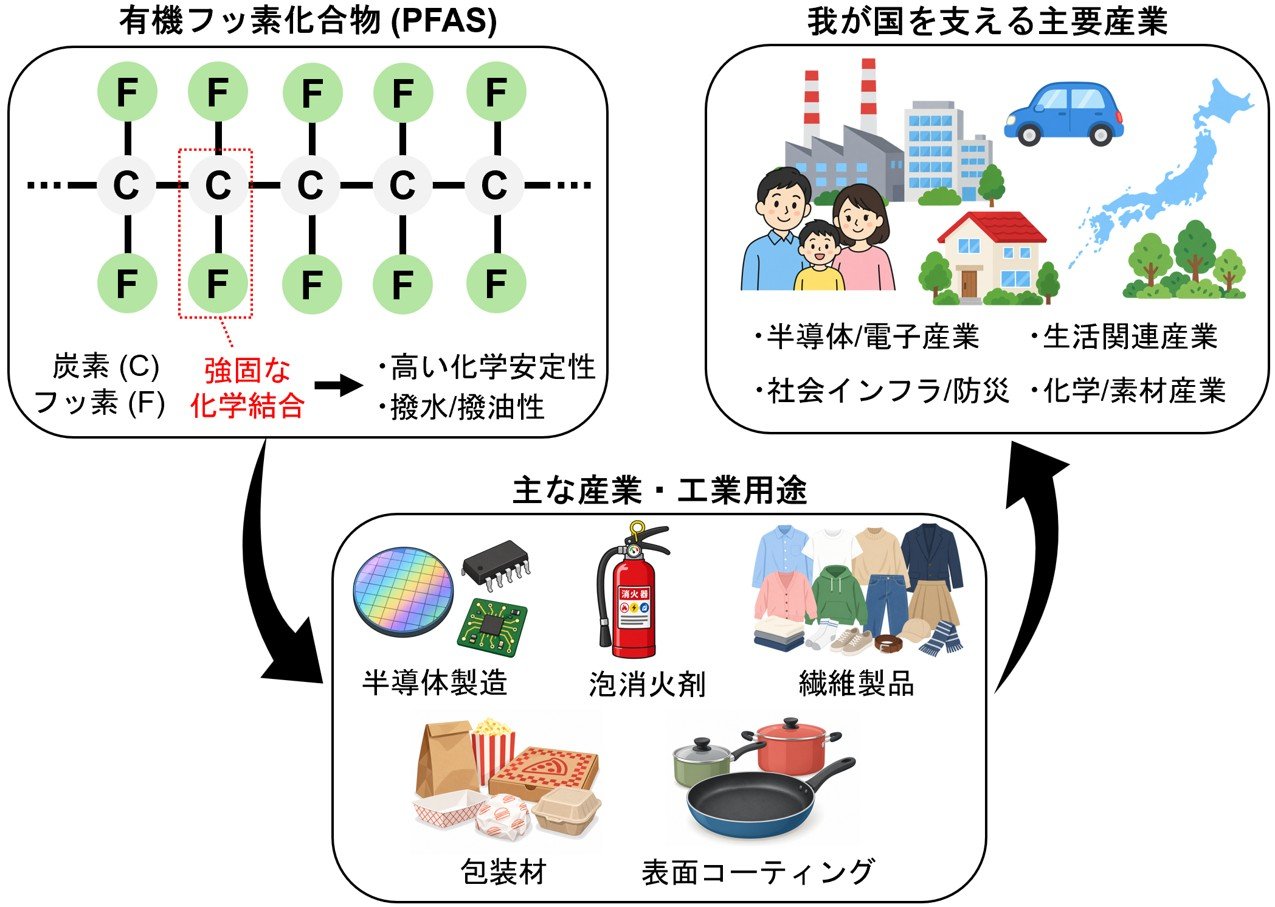
図1. PFASの特徴および主な産業・工業用途と関連産業
<関連情報>
- https://www.tohoku.ac.jp/japanese/2026/10/press20261006-04-PFAS.html
- https://pubs.acs.org/amacgu/article/doi/10.1021/acsmaterialsau.6c00168/5430937/Adsorption-of-Per-and-Polyfluoroalkyl-Substances
分子クラス全体にわたるパーフルオロアルキル物質およびポリフルオロアルキル物質の吸着:吸着挙動と吸着剤性能の理解 Adsorption of Per- and Polyfluoroalkyl Substances across Molecular Classes: Understanding Adsorption Behavior and Adsorbent Performance
Takahiro Ami;Aki Shibata;Hitoshi Kasai;Kouki Oka
ACS Materials Au Published:September 16, 2026
DOI:https://doi.org/10.1021/acsmaterialsau.6c00168
Abstract
Per- and polyfluoroalkyl substances (PFASs) have been widely used in industrial and commercial applications because of the exceptional chemical and thermal stability of their C–F bonds and their water- and oil-repellent properties. Some PFASs (hereafter called “specific PFASs”) have attracted increasing attention owing to concerns regarding their persistence, bioaccumulation potential, and possible effects on human health and ecosystems. Adsorption has emerged as a promising water-purification technology, and extensive efforts have been made to develop adsorbents for specific PFAS removal. Adsorption investigations have typically focused on long-chain PFASs represented by perfluorooctanesulfonate and perfluorooctanoic acid. Recent regulatory consideration has expanded regulation targets to short-chain PFASs, emerging fluorinated alternatives, and ultrashort-chain PFASs. Specific-PFAS adsorption is governed by a balance of hydrophobic, electrostatic, and host–guest interactions; therefore, adsorption behavior varies substantially with the PFAS molecular structure. Consequently, adsorbents that are highly effective for one PFAS class are not necessarily optimal for others. This review adopts a PFAS-centered perspective and classifies significant specific PFASs into four categories: (i) long-chain PFASs, (ii) short-chain PFASs, (iii) emerging alternative PFASs, and (iv) ultrashort-chain PFASs. The effective adsorbents for each specific-PFAS class are organized based on their adsorption mechanisms to clarify the relationships between the PFAS molecular characteristics and requirements for adsorption, providing guidance for adsorbent selection and design.