2026-10-05 福井県立大学,北海道大学
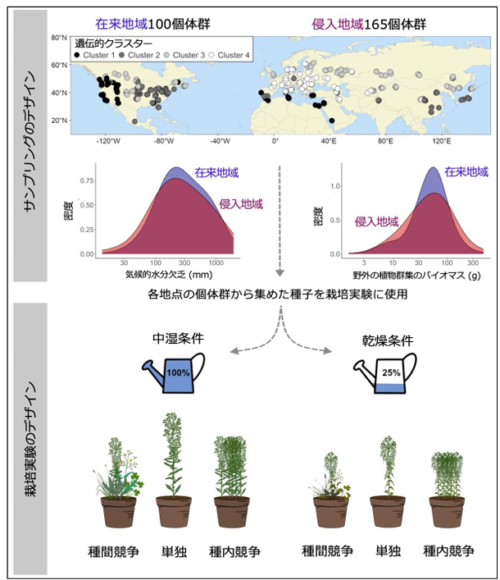
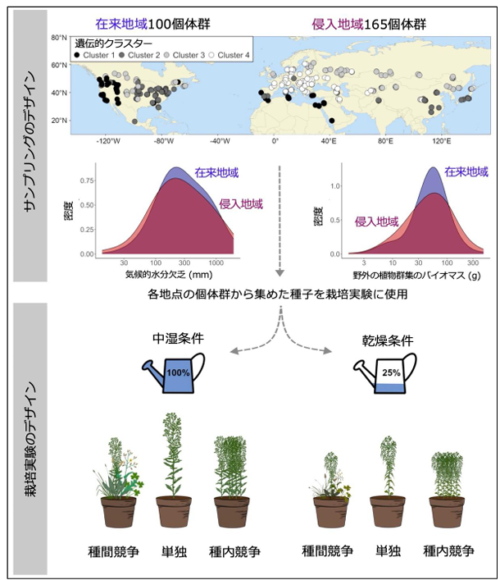
図1. ヒメムカシヨモギの競争力の急速な進化を研究するためのサンプリングのデザインおよび栽培実験のデザインの概要。
<関連情報>
- https://www.fpu.ac.jp/press-release/q156758_d/fil/gairaisixyokubutu.pdf
- https://www.nature.com/articles/s41467-026-77819-z
世界的な侵略者における競争力の急速かつ反復的な向上 Rapid and repeated evolution of increased competitive ability in a global invader
Dávid U. Nagy, Ragan M. Callaway, S. Luke Flory, Christopher D. Barratt, Walter Durka, Ylva Lekberg, Marilia S. Lucas, Stefan G. Michalski, Renske E. Onstein, Robert W. Pal, Julian Selke, Arpad E. Thoma, Mohammad M. Al-Gharaibeh, Ali A. Al-Namazi, Guadalupe Andraca-Gómez, Pål Axel Olsson, Shukherdorj Baasanmunkh, Sirwan Babaei, Fernando Bastida, Jonathan A. Bennett, Caio Brunharo, Darron A. Cullen, Ryan C. Donnelly, Alyson Ennis, … Christoph Rosche
Nature Communications Published:17 September 2026
DOI:https://doi.org/10.1038/s41467-026-77819-z
Abstract
Rapid adaptive evolution can increase the competitive ability of invasive species in their non-native ranges. However, whether this increase is a general response and what drives it remain uncertain because the evidence is largely based on studies with limited sampling, inadequate consideration of population co-ancestry, and oversimplified estimates of competitive ability. We conduct a large-scale glasshouse experiment testing the effects of competition and drought on 100 native and 165 non-native populations of Erigeron canadensis, all genotyped to account for co-ancestry. Plants from non-native populations are significantly more competitive against other species than the conspecifics from native populations under both mesic and dry conditions. Genetic clustering indicates that the rapid evolution of competitive ability occurs independently in two out of four clusters in the non-native range. This advantage is present only during interspecific interactions and is absent during intraspecific competition. Repeated evolution of increased competitive ability suggests that adaptation following introduction can reshape species interactions and promote invasion success, even under future drought conditions, highlighting the importance of rapid evolution in determining the ecological impacts of invasive plants.