2026-09-11 分子科学研究所
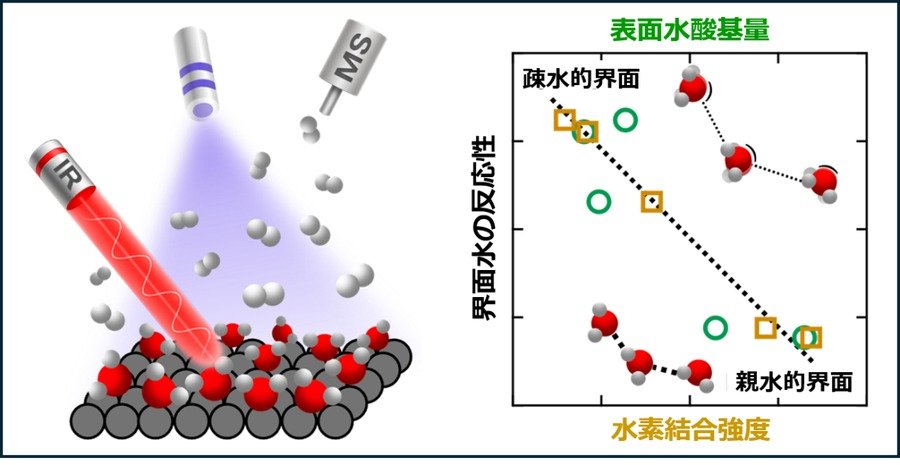
図1:アナターゼ型TiO₂光触媒における界面水の構造と反応性の関係。
<関連情報>
- https://www.ims.ac.jp/news/2026/09/0911.html
- https://pubs.acs.org/jpclcd/article/doi/10.1021/acs.jpclett.6c01721/5421828/Bridging-Interfacial-Water-Structure-and
TiO2界面 における光触媒水素発生における界面水構造と反応性の橋渡し Bridging Interfacial Water Structure and Reactivity in Photocatalytic Hydrogen Evolution at TiO2 Interfaces
Zhongqiu Lin;Hikaru Saito;Hiromasa Sato;Toshiki Sugimoto
The Journal of Physical Chemistry Letters Published:September 05, 2026
DOI:https://doi.org/10.1021/acs.jpclett.6c01721
Abstract
Understanding how interfacial water governs photocatalytic hydrogen evolution is a central challenge in the development of high-performance photocatalysts for a sustainable society. Although hydrophilic interfaces have long been regarded as favorable due to their strong water–catalyst interactions, the molecular-level relationship between the interfacial water structure and hydrogen-evolution reactivity remains unclear. Here, we establish a direct structure–reactivity correlation at the water–TiO2 interface using a series of anatase TiO2 nanoparticle photocatalysts. By combining real-time mass spectrometry with infrared spectroscopy under precisely controlled hydration conditions ranging from sub-monolayer to multilayer regimes, we quantitatively evaluate intrinsic hydrogen-evolution activity per water layer and per unit surface area. We show that stronger water–TiO2 interactions, characterized by higher adsorption energies and increased dissociative adsorption, correlate with lower H2 formation rates. Such strongly adsorbed water species form rigid hydrogen-bond networks that suppress interfacial water reactivity. In contrast, weaker water–TiO2 interactions accompanied by soft and flexible hydrogen-bond networks promote photocatalytic H2 evolution more efficiently. These findings demonstrate that optimal photocatalytic performance arises not from maximizing hydrophilicity but from tuning interfaces toward more hydrophobic environments that support dynamically flexible hydrogen-bond networks. This study provides a molecular-level framework for rational interface design in photocatalytic hydrogen evolution.