2026-10-05 京都大学
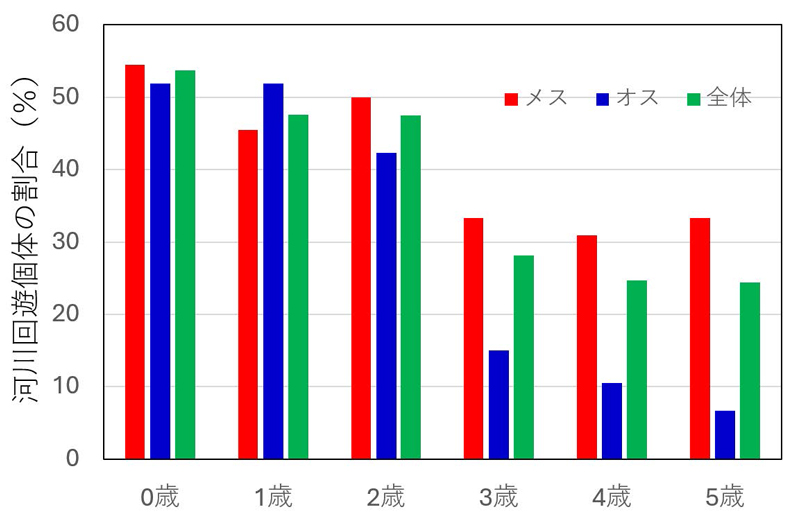
年齢別の河川利用率。成熟期(2歳から3歳)以降、オス(青)の河川利用率が大きく低下しました。赤:メス、緑:雌雄合計。
<関連情報>
- https://www.kyoto-u.ac.jp/ja/research-news/2026-10-05
- https://onlinelibrary.wiley.com/doi/10.1111/jfb.70664
耳石Sr:Ca比分析から明らかになった、成熟後のスズキの雌雄で異なる河川利用 Sex-dependent divergence in river use following maturation in Japanese seabass Lateolabrax japonicus revealed by otolith Sr:Ca chronologies
Yoh Yamashita, Kazuha Takai, Mari Kuroki, Kotaro Shirai, Yuki Terashima, Manabu Kume, Hiroyuki Togashi, Yutaka Kurita, Toshihiro Wada, Hiroaki Murakami, …
Journal of Fish Biology Published: 02 October 2026
DOI:https://doi.org/10.1111/jfb.70664
Abstract
Partial migration, in which migratory and resident individuals coexist within a population, is widespread in fishes and contributes to population resilience. However, the role of sex in shaping migratory strategies remains poorly understood. Herein, we examined partial migration in Japanese seabass Lateolabrax japonicus using sex ratios and otolith Sr:Ca chronologies. A total of 1847 individuals were collected from three Japanese regions (Sendai Bay, Tango Bay, Beppu Bay and rivers flowing into these three regions). Additionally, lifetime salinity histories were reconstructed for 206 individuals. Otolith analyses distinguished two contingents: river-migratory individuals that used river habitats and marine residents that remained in coastal waters throughout life. During their immature stages, both sexes frequently used riverine habitats; however, their migration trajectories diverged following maturation. Most males shifted to marine residency, whereas females continued river migration and exhibited strong fidelity to river systems. Furthermore, riverine habitats were strongly female-biased, with over 90% of adults being females. These findings provide evidence that sex-dependent divergence in migratory behaviour emerges at maturation in a marine amphidromous fish, underscoring a mechanism that may contribute to ecological flexibility and population stability.