

2026-09-28 合肥物質科学研究院(HFIPS)
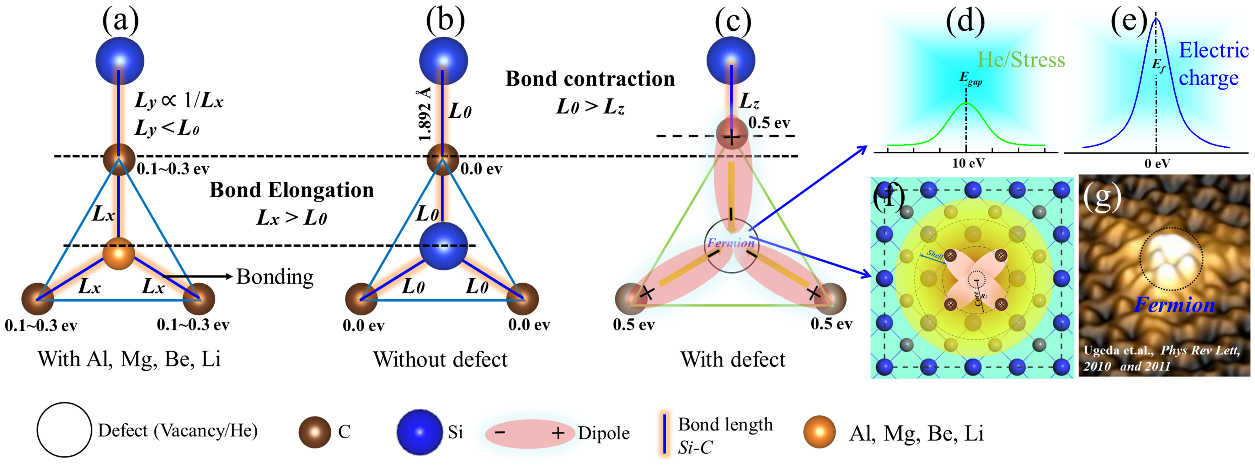
Bond contraction and Fermi level in SiC induced by vacancies or He. (Image by HUI Jun)
<関連情報>
- https://english.hf.cas.cn/nr/rn/202609/t20260928_1201537.html
- https://www.sciencedirect.com/science/article/pii/S0955221926006060
- https://www.sciencedirect.com/science/article/pii/S3050914926001822
実験および第一原理計算による、He⁺照射された3C-SiCにおけるHe-欠陥相互作用メカニズムと原子スケール擬似コアシェル構造の解明 Elucidation of He–Defect Interaction Mechanisms and Atomic-Scale Pseudo-Core–Shell Configurations in He⁺-Irradiated 3C-SiC via Experimental and First-Principles Calculations
Jun Hui, Bing Sheng Li, Xue Bang Wu
Journal of the European Ceramic Society Available online: 30 July 2026
DOI:https://doi.org/10.1016/j.jeurceramsoc.2026.118730
Abstract
This study examines the pseudo-core–shell structural characteristics and He–defect interactions in He⁺ irradiated 3C-SiC through a combination of experiments and first-principles calculations: i) He ion irradiation (500 keV, 1 ×10¹⁷ ions/cm²) induces the formation of nanobubbles (1.0–1.8 nm) and elongated platelets (6–10 nm), accompanied by pronounced lattice distortion and localized amorphization, indicating significant He aggregation and anisotropic growth; ii) Transmutation elements induce elongated C–X bonds and contracted C–SiX bonds, giving rise to a defect-driven pseudo -Core–Shell structure. He incorporation increases the core energy while stabilizing the shell, resulting in core instability; iii) He–vacancy interactions generate anomalous electronic states near the Fermi level and within the bandgap, originating from dipolar polarization of undercoordinated C atoms, providing insight into the coupled effects of He, defects, and transmutation elements in SiC and guiding the design of irradiation-tolerant cladding materials.
SiCにおける核殻構造の進化と劣化メカニズムに対する、核変換元素と溶融塩腐食の相乗効果 Synergistic effects of transmutation elements and molten salt corrosion on the evolution of core–shell structures and degradation mechanisms in SiC
Jun Hui, Xue Bang Wu
Transactions of Materials Research Available online 23 June 2026
DOI:https://doi.org/10.1016/j.tramat.2026.100341
Abstract
First-principles calculations combined with ab initio molecular dynamics (AIMD) simulations were conducted to investigate the behavior of transmutation elements (Al, Be, Mg, Li) and the precipitate element Ni, together with corrosive species from molten salts (F, Cl, O, N, B, H) within 3C–SiC. The results indicate that: i) All non-metallic species spontaneously adsorb on the SiC surface, with adsorption energies ranging from −6.52 to −2.60 eV (P < N < O < B < Cl < F < H); O, N, and B form stronger bonds, whereas Cl, F, and H exhibit weaker interactions. Transmutation metals show pronounced surface segregation, with energies spanning −5.78 eV < Li < Mg < Be < Ni < Al < −1.64 eV, indicating a strong preference of Li and Mg for interfacial accumulation; ii) interstitial non-metal doping induces characteristic core–shell structures, manifested as elongated X–Si bonds and shortened C–Si bonds. Be doping enhances local bonding and structural stability, whereas Mg and Li incorporation reduces mechanical integrity; iii) AIMD simulations at 1023 K reveal that F atoms form stable bonds in the presence of transmutation elements, resist diffusion to vacancies, but can induce new vacancy formation, promoting the accumulation of corrosive species; iv) density of states analysis shows that F doping and vacancies introduce localized states or anomalous peaks near the Fermi level, substantially altering the electronic structure and acting as potential corrosion-active centers.

