

2026-09-28 ノースウェスタン大学
<関連情報>
- https://news.northwestern.edu/stories/2026/09/wearable-nanotech-could-combat-nerve-agents
- https://pubs.acs.org/ancac3/article-abstract/20/35/24429/5328577/Catalytic-Porous-Metallized-Melanin-for-the
有機リン系化合物の浄化のための触媒活性多孔質金属化メラニン Catalytic Porous Metallized Melanin for the Remediation of Organophosphorus Agents
Sofia Aman;Shengyi Su;Wanjie Xie;JinLei Cui;Zofia E. Siwicka;Xuhao Zhou;Nathan D. Rosenmann;Kent O. Kirlikovali;Matthew D. Shawkey;Omar K. Farha;Nathan C. Gianneschi
ACS Nano Published:August 25, 2026
DOI:https://doi.org/10.1021/acsnano.6c06991
Abstract
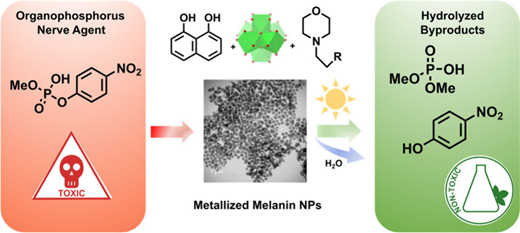
Hydrolytic detoxification of organophosphorus agents remains a central challenge in the design of protective and environmental materials, requiring precise integration of catalytic reactivity, accessible porosity, and chemical functionality. Melanin is a multifunctional material commonly known for its role in metal chelation, UV radiation protection, photothermal conversion, and structural coloration. Recently, high surface area synthetic 1,8-DHN-based allomelanin (AM) analogs have been described, exhibiting adsorption of organophosphorus (OP) chemical warfare agents (CWAs) simulants. Such affinity to OP and their intrinsic microporosities, together with the hydrophilicity and colloidal stability, make AM an ideal candidate for the capture of OP agents. However, the lack of catalytic active sites in AM poses challenges for the complete remediation of OP agents. In this work, we describe two complementary methods for successful incorporation of Lewis acid metal active sites via metal salts and clusters within and at the surface of AM through pre- and post-polymerization strategies. We demonstrate that these AM composites with hexanuclear zirconium-oxo clusters effectively hydrolyze the nerve agent simulant in dimethyl 4-nitrophenyl phosphate (DMNP), reaching a half-life of 10 min with only 1 mol % catalyst loading while maintaining the polymer’s intrinsic photothermal properties. These composite particles maintain their activity after multiple hydrolysis cycles with minimal metal leaching. Combining the photothermal properties of DHN-melanin and the versatility of the pre- and post-polymerization methods, we successfully synthesized base-incorporated metal-loaded melanin composites to achieve light-accelerated detoxification of OP without the addition of external bases. The significant enhancement of reactivity in the engineered AM demonstrates that this dual-functionalization strategy is an effective route to embed complex catalytic capabilities within these intrinsically porous nanoparticles.

