2026-09-04 シカゴ大学(UChicago)

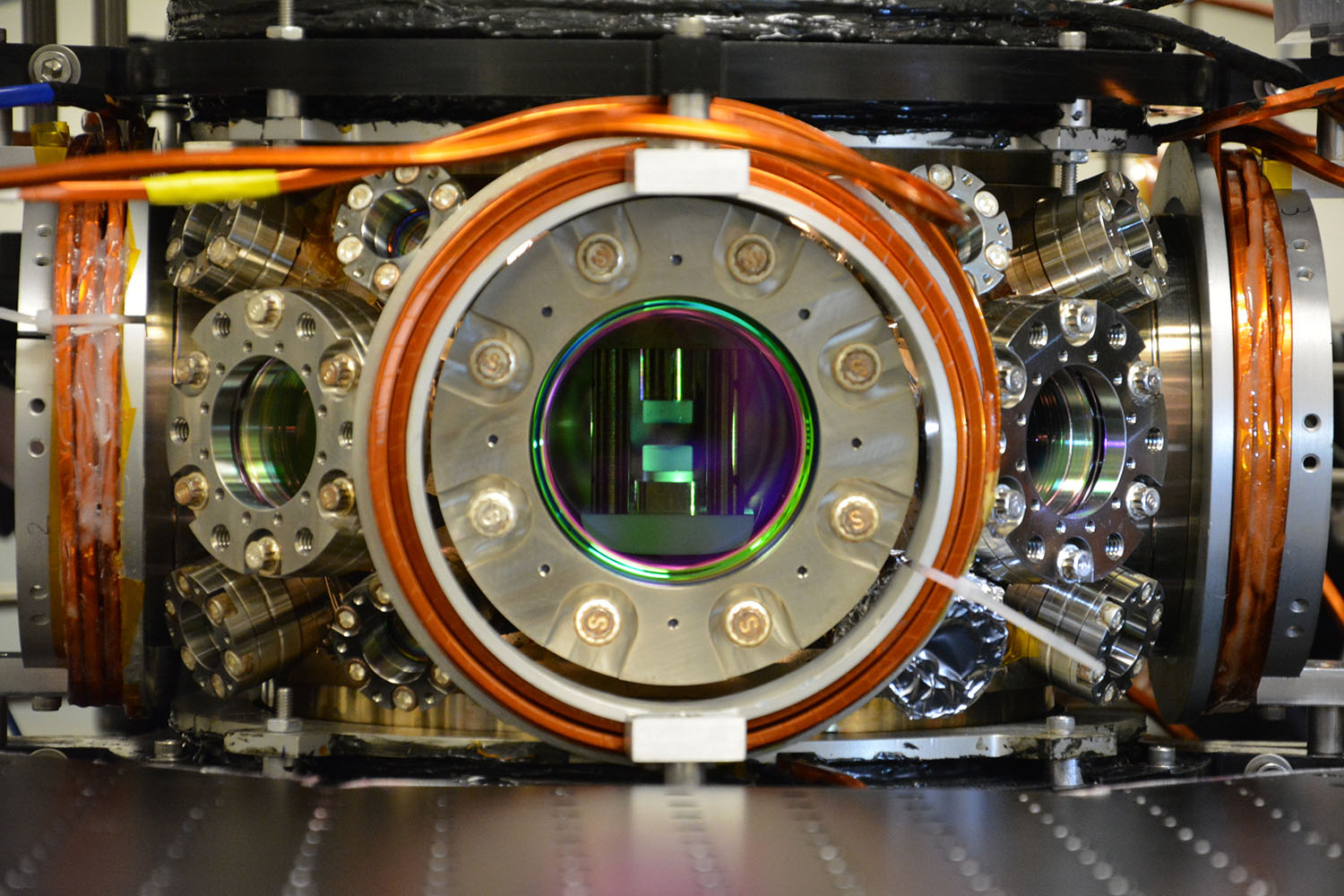
The Fast Interaction Trigger detector is installed at the Large Hadron Collider in 2022. A group of UChicago-led scientists is exploring ways to improve how particle collision data is evaluated at the collider.Photo courtesy of Wladyslaw Henryk Trzaska/CERN
<関連情報>
- https://news.uchicago.edu/story/uchicago-led-team-builds-ai-data-filter-cerns-particle-collider
- https://computerscience.uchicago.edu/news/when-artificial-intelligence-meets-physics-beneath-the-french-swiss-border/
- https://arxiv.org/abs/2606.23993
トリガー学習:大型ハドロン衝突型加速器における強化学習 Learning to Trigger: Reinforcement Learning at the Large Hadron Collider
Zixin Ding, Shaghayegh Emami, Giovanna Salvi, Cecilia Tosciri, Abhijith Gandrakota, Jennifer Ngadiuba, Nhan Tran, Christian Herwig, David W. Miller, Yuxin Chen
arXiv last revised 27 Jun 2026 (this version, v3)
DOI:https://doi.org/10.48550/arXiv.2606.23993
Abstract
High-throughput scientific facilities such as the Large Hadron Collider depend on real-time event filtering (\textit{triggering}) under tight constraints on bandwidth, latency, and storage. In practice, trigger menus are largely static and hand-tuned and can become suboptimal as detector conditions, pileup, and background composition drift over time. We cast online threshold tuning as a sequential decision-making problem: a reinforcement learning agent ingests streaming summaries of recent rates and signal-sensitive features and updates trigger thresholds to maximize signal efficiency while tracking a target background rate within a tolerance band. We adapt Group-Filtered Policy Optimization (GFPO) to streaming control and introduce two variants (GFPO-F, GFPO-FR) that enforce background rate feasibility during training. On a benchmark that emulates realistic collider operation, we study two representative triggers: a total transverse energy (HT) trigger sensitive to pileup variation, and an anomaly-detection (AD) trigger based on reconstruction loss for rare or non-standard signatures. On Monte Carlo streams, our agent increases the fraction of in-tolerance time intervals by 48\% (HT) and 28\% (AD), with a cumulative gain of up to 2\% in signal efficiency on those in-tolerance intervals. Transferring from simulation to \emph{real} collision data (CMS Run 283408), the same agent, without fine-tuning, achieves a 56\% (HT) and 28\% (AD) in-tolerance improvement over baselines, with further signal-efficiency gain on both triggers. To our knowledge, this is the \emph{first} demonstration of RL-based trigger control on real Large Hadron Collider collision data. Code is available at this https URL (see repo for details).