2026-09-10 北海道大学,株式会社ニトリホールディングス
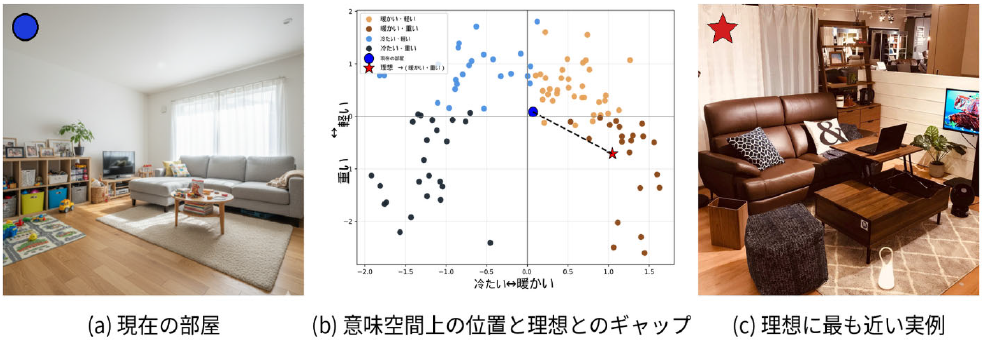
現在の部屋(a)と、言葉で表した理想のスタイルを同じスタイル意味空間上に配置(b)。その差(スタイルギャップ)をもとに、理想に近い部屋の例を提示できる(c)。
<関連情報>
- https://www.hokudai.ac.jp/news/2026/09/ai-12.html
- https://ieeexplore.ieee.org/abstract/document/11630254
大規模マルチモーダルモデルの表現を用いた解釈可能なインテリアスタイル意味の学習 Learning Interpretable Interior Style Semantics via Large Multimodal Model Representations
Junya Yamamori; Ren Togo; Teruhisa Yamashiro; Takahiro Ogawa; Miki Haseyama
2026 IEEE International Conference on Image Processing (ICIP) Date Added to IEEE Xplore: 13 August 2026
DOI:https://doi.org/10.1109/ICIP61757.2026.11630254
Abstract
Large multimodal models (LMMs) provide rich image–text latent representations, but representing abstract concepts such as interior style within human-interpretable semantic spaces remains challenging. We propose a framework that constructs a two-dimensional interior style semantic space by linearly aligning image and language latent representations of an LMM using style descriptions. The resulting space represents abstract styles, such as Cool–Warm and Light–Heavy, as continuous semantic axes. Experiments on expert-labeled interior images show that the proposed method achieves higher cluster separability and style classification accuracy than direct projection onto pretrained vision–language spaces. We further demonstrate that the constructed space enables quantitative analysis of stylistic differences between current and ideal interiors.