2026-09-04 東京科学大学
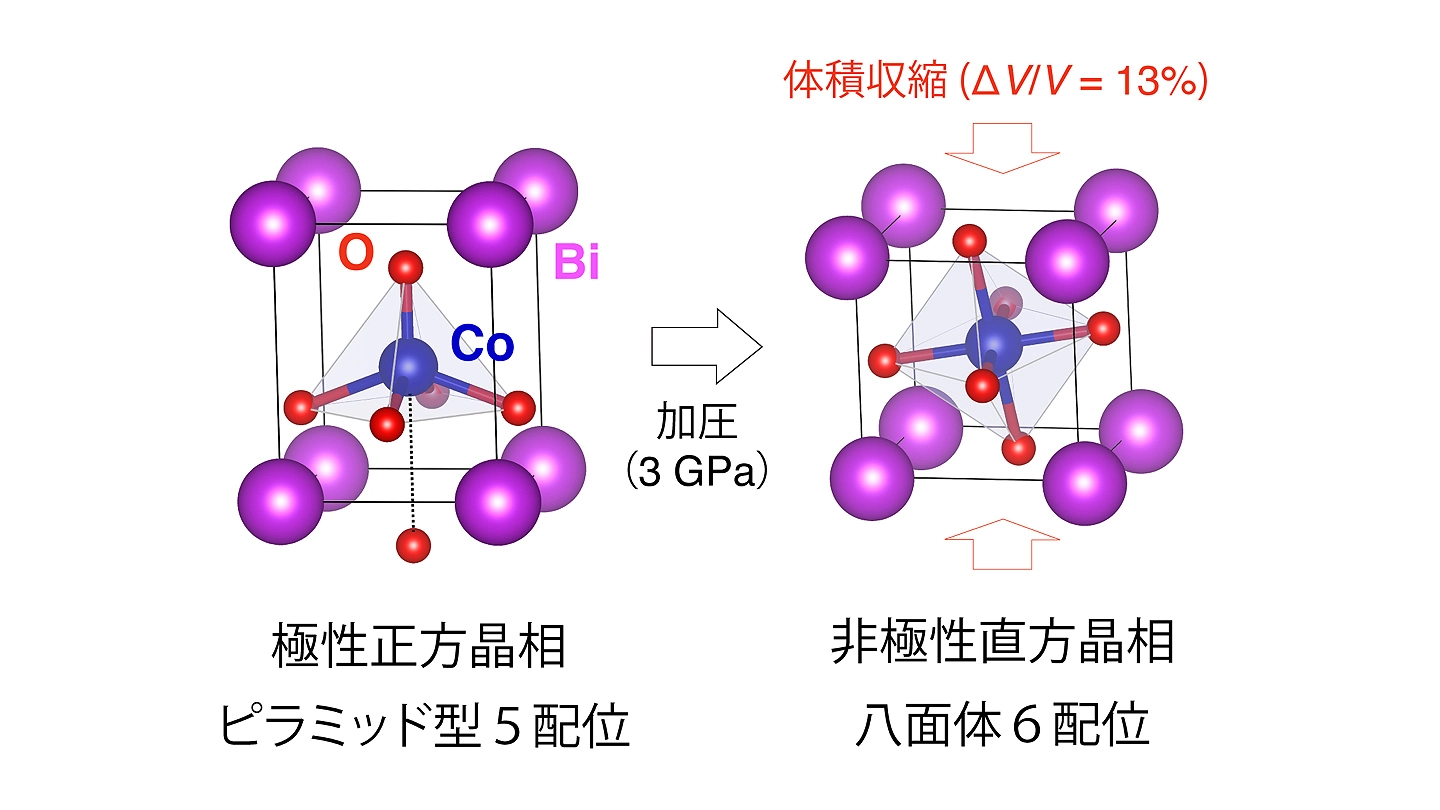
図1. コバルト酸ビスマスBiCoO3の圧力下での結晶構造の変化。CoO5ピラミッド型5配位の極性正方晶構造から、CoO6八面体6配位の非極性直方晶構造への構造相転移により、13%の巨大体積収縮が生じる。
<関連情報>
- https://www.isct.ac.jp/ja/news/u1xcbnm4qj0s
- https://advanced.onlinelibrary.wiley.com/doi/10.1002/advs.77022
鉛フリー Bi 1− x Ln x CoO 3 ( Ln : ランタノイド)における可逆的な再構成相転移によって誘発される 6.1% の体積負熱膨張 6.1% Volumetric Negative Thermal Expansion Induced by the Reversible Reconstructive Phase Transition in Pb-Free Bi1−xLnxCoO3 (Ln: Lanthanoid)
Yuki Sakai, Kazuki Takahashi, Shogo Wakazaki, Takumi Nishikubo, Jun Miyake, Takehiro Koike, Teppei Nagase, Takafumi Yamamoto, Kano Hatayama, Masaichiro Mizumaki, Masaki Azuma
Advanced Science Published: 03 September 2026
DOI:https://doi.org/10.1002/advs.77022
ABSTRACT
Negative thermal expansion (NTE) materials, which can compensate for the thermal expansion of structural materials, have attracted much attention in the field of nanoscale electronics and optical devices requiring precise positioning. The present paper demonstrates a reversible colossal NTE in the perovskite-type oxide lanthanoid-substituted BiCoO3. The 6.1% volume shrinkage in Bi0.82Nd0.18CoO3 is the largest ever observed in Pb-free NTE materials. Synchrotron X-ray diffraction and Co L-edge soft X-ray absorption spectroscopy measurements and machine learning force field molecular dynamics simulations confirm that the origin of the NTE is the coordination change from the CoO5 pyramid with high-spin Co3+ to the CoO6 octahedron with the LaCoO3-type Co3+ spin state (intermediate-spin state or mixture of high-spin and low-spin states) due to melting of the dxy orbital ordering in the d6 electron configuration. The NTE properties as functions of ionic radius and concentration of substituting Ln ions are well explained by the nucleation mechanism of the reconstructive martensitic phase transition. The present results offer a new strategy for developing large-NTE materials.