2026-09-04 東京理科大学,科学技術振興機構
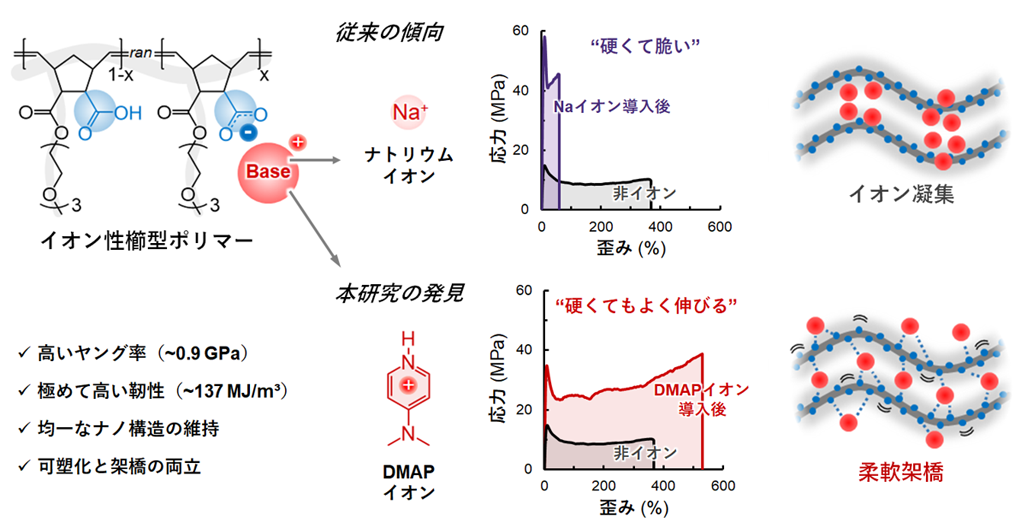
図. 本研究結果の概要
<関連情報>
- https://www.tus.ac.jp/today/archive/20260904_8621.html
- https://pubs.acs.org/mamobx/article/doi/10.1021/acs.macromol.6c00773/5410884/Anomalous-Toughening-of-Glassy-Ionic-Comb-Polymers
ガラス状イオン性コームポリマーの異常な強化:かさ高い4-ジメチルアミノピリジニウム対イオンによる均一性の維持 Anomalous Toughening of Glassy Ionic Comb Polymers: Retention of Homogeneity Achieved by Bulky 4-Dimethylaminopyridinium Counterions
Kotaro Uchiyama;Ryotaro Miyazawa;Daisuke Aoki;Koji Arimitsu
Macromolecules Published:September 03, 2026
DOI:https://doi.org/10.1021/acs.macromol.6c00773
Abstract
Overcoming the trade-off between stiffness and toughness is a longstanding challenge for glassy polymers. While ionic toughening with a homogeneous nanostructure offers a potential solution, this behavior remains limited to specific ionic liquid-based systems. Here, we show that incorporating 4-dimethylaminopyridine (DMAP) as a counterion into ionic comb polymers enables effective toughening while maintaining a homogeneous nanostructure. Specifically, the DMAP-neutralized ionic comb polymers demonstrate exceptional toughness (∼137 MJ/m3) and high elastic modulus (∼0.9 GPa)—representing fourfold and twofold increases, respectively, over the non-ionic precursor. SAXS analysis confirmed that these systems maintain a homogeneous nanostructure despite their highly ionized state, as verified by FT-IR. Moreover, DMAP counterions effectively plasticize the polymer matrix, lowering the glass transition temperature (Tg) from 96 to 81 °C. These findings suggest that homogeneous ionic crosslinking, enabled by the combination of bulky side chains and organic bases, is a promising strategy for toughening glassy polymers.