2026-08-28 コペンハーゲン大学(UCPH)
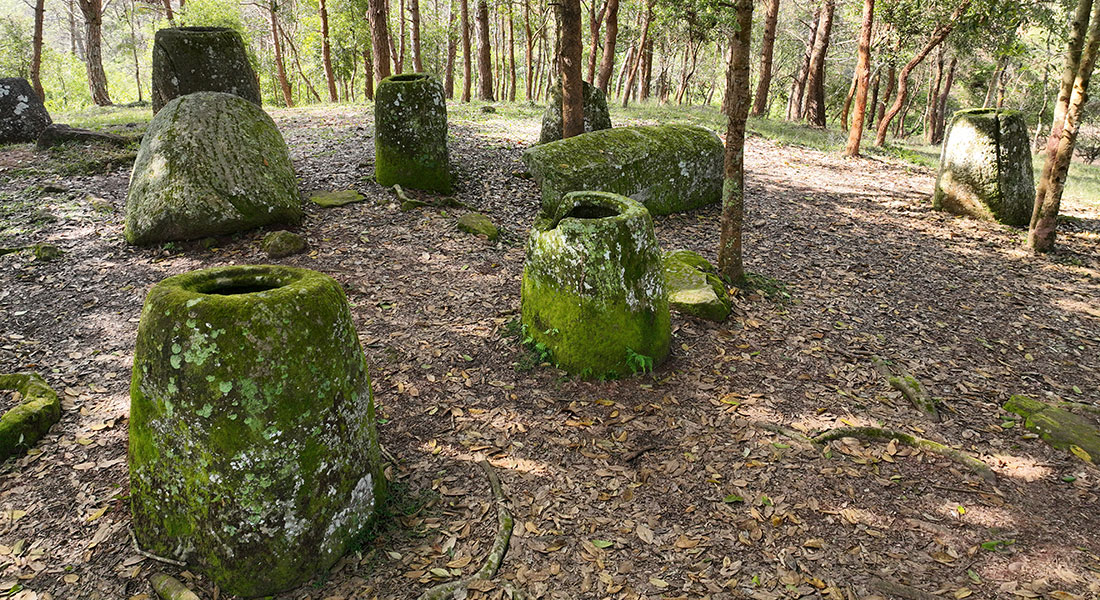
This is the first time the jars have been studied in a biological research context. Photo: Claus Christensen
<関連情報>
- https://news.ku.dk/all_news/2026/08/unresolved-jar-mystery-becomes-a-2000-year-natural-experiment/
- https://nsojournals.onlinelibrary.wiley.com/doi/10.1002/ecog.07995
世界最古の人為的な生物実験 The world’s oldest man-made biological experiment
Laura Käse, Chanvilay Somvongsa, Khamla Inkhavilay, Claus Christensen, Lars Lønsmann Iversen, Ole Pedersen, Lars Baastrup-Spohr
Ecography Published: 30 November 2025
DOI:https://doi.org/10.1002/ecog.07995
Abstract
Biological experiments are often short-lived due to logistical or resource-related challenges, and short-term observations are extrapolated to make long-term predictions. However, the effects of experimental treatments on biological communities and processes take time to develop. Consequently, the robustness of conclusions drawn from observations increases with the duration of the experiment. As a striking real-world example, and scattered throughout central Laos, thousands of large stone jars have been left behind from ancient burial rituals. The most famous sites in the Xiengkhouang province are collectively referred to as the Plain of Jars. These jars form a massive biological experiment: for approximately 2000 years, rainwater has interacted with the geological origin of each jar to create unique yet replicated aquatic ecosystems influenced by different tree cover levels. The layout of these jars, with clusters of up to several hundred jars separated by several kilometers, allows for controlled testing of multiple questions within ecology and evolution. Here, we report, for the first time, how these ancient mesocosms can be used to test ecosystem responses to local abiotic variation and disturbance. We show that tree cover dominates every jar ecosystem’s state, and that variations in tree cover density create gradients in oxygen (O2) and nutrient concentrations among jar ecosystems. These initial findings show that litter contribution to aquatic ecosystems leads to higher nutrient content and lower O2 concentration, even in systems under different long-term selection, in the oldest man-made ecosystems ever analyzed. This first environmental analysis provides a fundamental understanding of a unique environment and offers trajectories for future exploration.