2026-08-07 中国科学院(CAS)
<関連情報>
- https://english.cas.cn/newsroom/research-news/202608/t20260810_1186978.shtml
- https://link.springer.com/article/10.1007/s11104-026-08812-0
熱帯の共通圃場における種内根形質変異が根圏土壌生物の多様性とネットワークの複雑性に及ぼす影響 Intraspecific root traits variations affect rhizosphere soil biota diversity and network complexity in a tropical common garden
Mingke Fang,Hao Zhang,Xinyao Yang,Shangwen Xia & Xiaodong Yang
Plant and Soil Published:02 July 2026
DOI:https://doi.org/10.1007/s11104-026-08812-0
Abstract
Background and aims
Plant intraspecific trait variation (ITV) is critical for community assembly and functioning. However, its effect on rhizosphere microbes and the nematode micro-food web has rarely been explored.
Methods
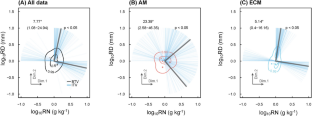
To investigate how ITV affects rhizosphere bacteria, fungi, and nematode communities, we selected twelve tree species representing arbuscular mycorrhizal (AM) and ectomycorrhizal (ECM) types in a tropical common garden and assessed their root traits in root economics space (RES) and root exudate, rhizosphere soil properties, and rhizosphere soil biota communities.
Results
Root ITV significantly altered the between-species trait variation in RES, which captures trade-offs in ‘collaboration’ and ‘conservation’ gradients that ranging from ‘DIY’ (do-it-yourself) to ‘outsourcing’ and ‘fast’ to ‘slow’ strategies. The soil properties were also captured by ‘nutrient’ and ‘pH’ gradients. Collectively, ECM trees exhibiting ‘DIY’ and ‘fast’ root strategies, as well as inhabiting soils with higher nutrient levels, were associated with increased rhizosphere fungal and nematode diversity. And AM trees inhabiting soils with elevated pH were associated with increased bacterial diversity. Both ECM and AM trees with a ‘fast’ root strategy enhanced cross-guild co-occurrence network complexity, and with higher nutrient levels and pH values increased within-guild network complexity. Notably, the intraspecific variations in root traits and soil properties exerted more shifts in rhizosphere soil biota diversity and network complexity in ECM trees relative to AM trees.
Conclusion
This study demonstrates the role of plant ITV in structuring rhizosphere soil biota and highlights the importance of plant phenotypic diversity for soil community assembly and functioning.