2026-09-30 中国科学院(CAS)
中国科学院西双版納熱帯植物園などの研究チームは、熱帯から亜高山帯までの標高勾配に沿って、同じ樹木の葉と根が異なる化学的防御戦略をとることを明らかにした。183樹種を対象に非標的メタボロミクスを行い、葉・根の代謝物組成を植食、土壌条件、植物多様性、系統関係などと統合解析した。その結果、葉と根のメタボロームは森林タイプを問わず明確に異なり、特に根の化学組成は標高に伴う変化が大きかった。葉・根とも標高上昇に伴って化学的多様性は低下したが、葉では専門食植者による被害と多様性が正相関し、葉・根の双方では土壌養分の増加と多様性が負相関した。また、低地の葉は比較的極性が高く低コストな代謝物を多く含む一方、高標高では芳香族性・構造剛性が高くコストの大きい代謝物へ移行した。根では逆の傾向がみられ、植物全体の化学戦略は器官機能と環境条件によって異なることが示された。
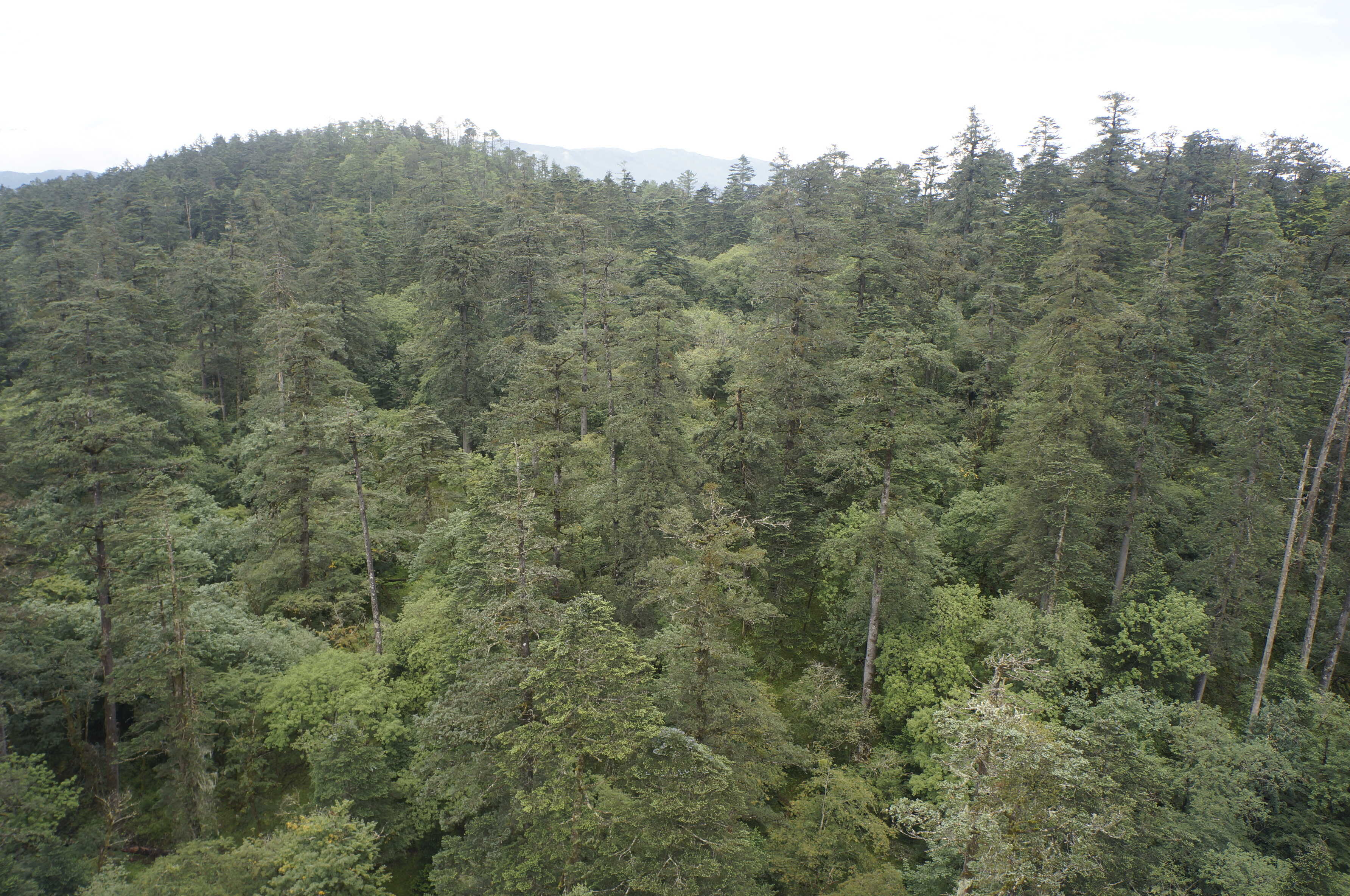
Subalpine froest. (Image by HUANG Hua)
<関連情報>
- https://english.cas.cn/newsroom/research-news/202609/t20260930_1201598.shtml
- https://nph.onlinelibrary.wiley.com/doi/10.1111/nph.71603
標高勾配に沿った地上部と地下部の樹木器官間の植物化学的差異 Phytochemical divergence between above- and belowground tree organs along elevational gradients
Mengesha Asefa, Lu Sun, Yazhou Zhang, Susan R. Whitehead, Guorui Xu, Xiaoyang Song, Min Cao, Yunyun He, Yao Su, Jie Yang, Nathan G. Swenson
New Phytologist Published: 22 September 2026
DOI:https://doi.org/10.1111/nph.71603
Summary
- Plants produce diverse metabolites to defend against biotic and abiotic stresses. However, quantification of plant chemical defenses along environmental gradients has largely focused on aboveground organs, leaving belowground patterns poorly understood.
- To address how leaf and root defense chemistry shifts with changing biotic and abiotic conditions, we compared untargeted metabolomics of 183 species across elevational gradients spanning tropical, subtropical, and subalpine forests.
- Leaves and roots showed distinct chemical compositions across elevations, with phytochemical diversity declining from tropical to subalpine forests, corresponding with shifts in herbivore pressure and soil conditions. These patterns suggest that local variation in biotic and abiotic pressures across elevations may be associated with gradients in phytochemical diversity. We also uncovered contrasting patterns of chemical strategies between organs. Leaf chemistry shifts from polar, fast-turnover, low-cost metabolites in tropical forests to less polar, aromatic, and energetically costly metabolites in subtropical and subalpine forests, whereas roots display contrasting metabolic adjustments.
- Our results suggest that elevation filters species by their distinct metabolomic profiles, with organ-specific and context-dependent chemical investment, highlighting the importance of integrating above- and belowground organs to understand plant chemical responses across gradients. We reveal that organs of the same tree tell distinct chemical stories, illuminating the chemical life of trees.