2026-07-30 東京大学
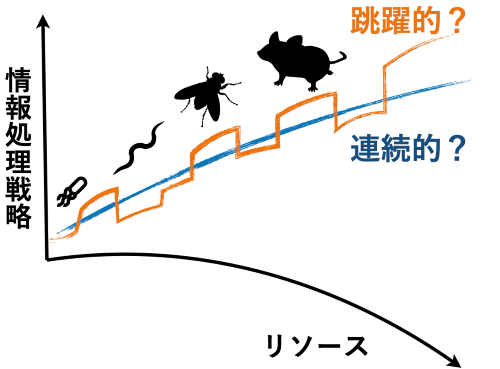
利用可能なリソースの変化による生体情報処理の最適戦略の変化
<関連情報>
- https://www.iis.u-tokyo.ac.jp/ja/news/5116/
- https://journals.aps.org/prl/abstract/10.1103/5ynb-7k4v
- https://journals.aps.org/prresearch/abstract/10.1103/nz4j-tyv1
資源量に起因する推定戦略における相転移の理論的分析 Theoretical Analysis of Resource-Induced Phase Transitions in Estimation Strategies
Takehiro Tottor and Tetsuya J. Kobayashi
Physical Review Letters Published: 28 July, 2026
DOI: https://doi.org/10.1103/5ynb-7k4v
Abstract
Organisms adapt to volatile environments by integrating sensory information with internal memory, yet their information processing is constrained by resource limitations. Such limitations can fundamentally alter optimal estimation strategies in biological systems. For example, recent experiments suggest that organisms exhibit phase transitions between memoryless and memory-based estimation strategies depending on energy availability and sensory reliability. However, a theoretical understanding of how resource limitations induce these transitions is still missing. This Letter presents an analytical characterization of the resource-induced phase transitions in optimal estimation strategies. Our results identify the conditions under which resource limitations alter estimation strategies and analytically reveal the mechanism underlying the emergence of discontinuous, nonmonotonic, and scaling behaviors. These results provide a theoretical foundation for understanding how limited resources shape information processing in biological systems.
資源の制約は生物学的情報処理における相転移を引き起こす Resource limitations induce phase transitions in biological information processing
Takehiro Tottori and Tetsuya J. Kobayashi
Physical Review Research Published: 14 October, 2025
DOI: https://doi.org/10.1103/nz4j-tyv1
Abstract
Biological information processing exhibits remarkable diversity across different organisms, which is presumably shaped by evolutionary optimization under limited resources. Starting from simple memoryless responses, more complex memory-based strategies may have evolved as resources became more available. In this Letter, we investigate minimal models of biological information processing under resource limitations by applying an optimal control technique proposed in [Tottori and Kobayashi, Phys. Rev. Res. 7, 043048 (2025)]. We find that resource limitations such as sensing reliability, intrinsic stochasticity, and energy cost induce discontinuous phase transitions between memoryless and memory-based strategies, even though the minimal models fall within the standard linear-quadratic-Gaussian class. Moreover, these transitions can be nonmonotonic: Optimal information processing initially shifts from memoryless to memory-based strategies as sensing reliability increases, but then reverts to memoryless strategies if it increases further. Our results suggest that the complexity of biological information processing may be an evolvable trait that can switch back and forth between distinct strategies in a punctuated manner.