2026-07-30 中国科学院(CAS)
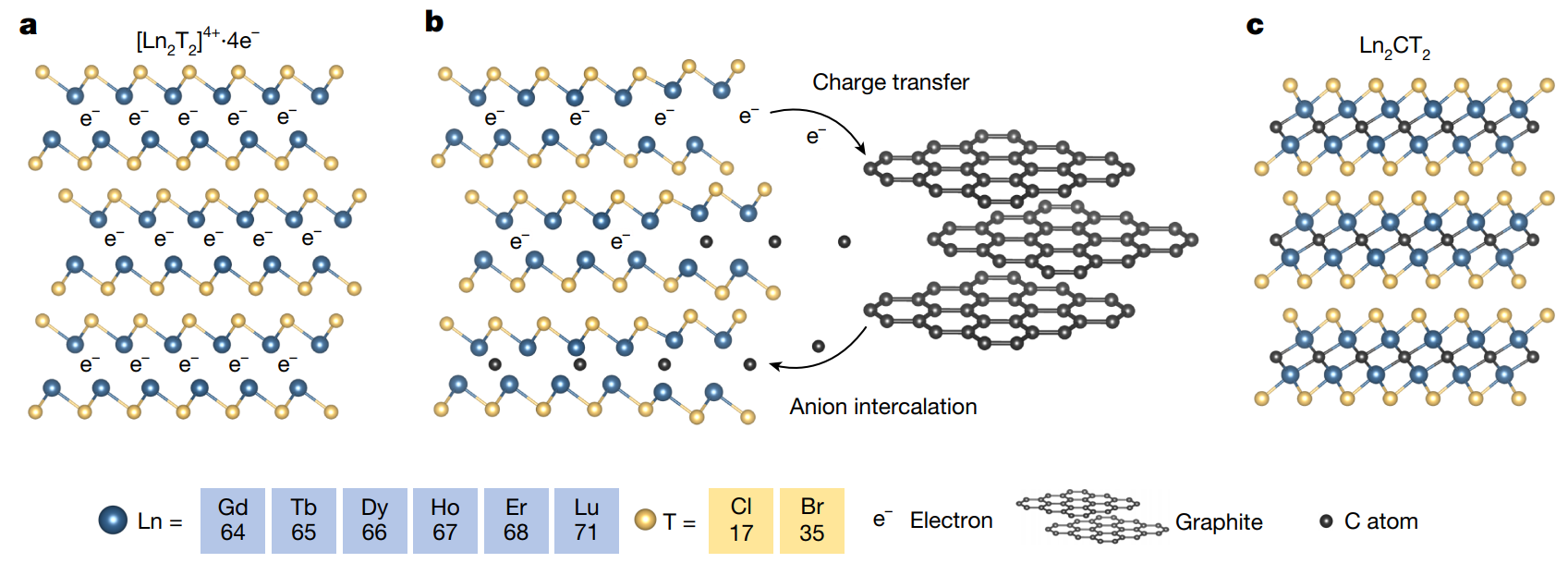
Synthesis process of lanthanide MXenes (Image by NIMTE)
<関連情報>
- https://english.cas.cn/newsroom/research-news/202607/t20260730_1183456.shtml
- https://www.nature.com/articles/s41586-026-10802-2
層間挿入ハロゲン化物から得られる半導体および磁性ランタニドMXene Semiconducting and magnetic lanthanide MXenes from intercalated halides
Qian Fang,Liming Wang,Kai Chang,Hongxin Yang,Pu Yan,Kecheng Cao,Mian Li,Jianming Xue,Xiaoping Ouyang,Zhifang Chai & Qing Huang
Nature Published:22 July 2026
DOI:https://doi.org/10.1038/s41586-026-10802-2
Abstract
Two-dimensional (2D) magnetic semiconductors are crucial for next-generation information storage and spintronic technologies1,2. MXenes, owing to compositional diversity and tunable properties, provide a platform for designing functional materials3,4,5. Incorporating lanthanides (Ln) introduces localized 4f electrons with strong spin polarization, while potentially enabling semiconducting behaviour, offering a viable route to magnetic semiconductors6,7. However, the scarcity of MAX precursors and the susceptibility of Ln to dissolution in common etchants (for example, HF), compared with other M elements such as Mo, hinder the synthesis of lanthanide MXenes (Ln2CT2) by conventional ‘top-down’ etching8. Here we propose a general ‘bottom-up’ methodology for synthesizing Ln2CT2 (Ln = Gd, Tb, Dy, Ho, Er, Lu; T = Cl, Br) using layered halides as van der Waals building blocks. Multilayer Ln2CT2 exhibits composition-tunable properties, characterized by optical absorption onsets spanning 1.26–1.71 eV, room-temperature resistivity of 0.329–36.1 Ω cm with a negative temperature coefficient, and low-temperature ferromagnetic hysteresis at 2 K accompanied by positive Curie–Weiss temperatures between 6 K and 59 K. Theoretical calculations show that the d-electron states around the Fermi level (Ef) are largely diminished in bare Ln2C, whereas surface terminals further exhaust these states to open band gaps. Meanwhile, the highly localized 4f electrons in Ln2CT2, located far from the Ef, contribute to the spin splitting for the observed ferromagnetic behaviour. This combination of semiconducting and magnetic properties makes Ln2CT2 a valuable candidate for spintronic device applications.