2026-07-10 シカゴ大学(UChicago)
<関連情報>
- https://news.uchicago.edu/story/researchers-build-light-powered-artificial-leaf-wireless-medical-implants
- https://www.nature.com/articles/s41566-026-01949-5
ホットキャリア生体電子インターフェースのための自己組織化ナノプラズモニック人工葉 Self-organized nanoplasmonic artificial leaf for hot-carrier bioelectronic interfaces
Pengju Li,Mengzhan Liufu,Cooper R. Johnston,Young-Woo Pyo,Yuze Zheng,Guangqing Yang,Ananth Kamath,Ruipeng Li,Yuzi Liu,Carlos A. Z. Bassetto Jr,Jinxing Jiang,Ashley Arcidiacono,Chuanwang Yang,Tiantian Guo,Ji Wan,Jing Zhang,Zirui Zhou,Joseph Strzalka,Fengyuan Shi,Jiping Yue,Lance Emry,Jwwad Javed,Isabel Vargas-Hurlston,Richard D. Schaller,… Bozhi Tian
Nature Photonics Published:24 June 2026
DOI:https://doi.org/10.1038/s41566-026-01949-5
Abstract
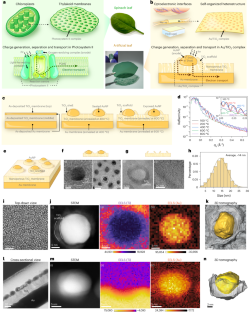
Without discrete pixels or wired leads, natural plant leaves respond to light and relay electrochemical signals to surrounding tissues through nanoscale chlorophyll-containing protein complexes—an elegant capability sought in next-generation leadless optoelectronic systems. Although semiconductors and their heterojunctions are commonly used to mimic photosynthesis, nanoplasmonic structures offer a largely untapped alternative. Harnessing plasmonic hot carriers for macroscopic systems remains challenging, limiting applications in tissue-level neuromodulation and human–machine interfaces. We introduce a hot-carrier artificial leaf optoelectronic device, formed by thermally self-organized three-dimensional gold-titanium dioxide units on ultrathin membranes. These nanoplasmonic interfaces enhance visible-light optoelectronic responsiveness at sub-100-nm thickness, support highly localized hot-carrier injection, and exhibit stable, linear performance over a wide range of light intensities, overcoming the material, bandgap and carrier diffusion limits of conventional semiconductors. The resulting nanoplasmonic devices enable leadless, multimodal optoelectronic modulation and pixel-less optical pattern recognition, presenting a potentially scalable platform for hot-carrier-enabled biomedical and human–machine interface technologies.