2026-07-07 東北大学
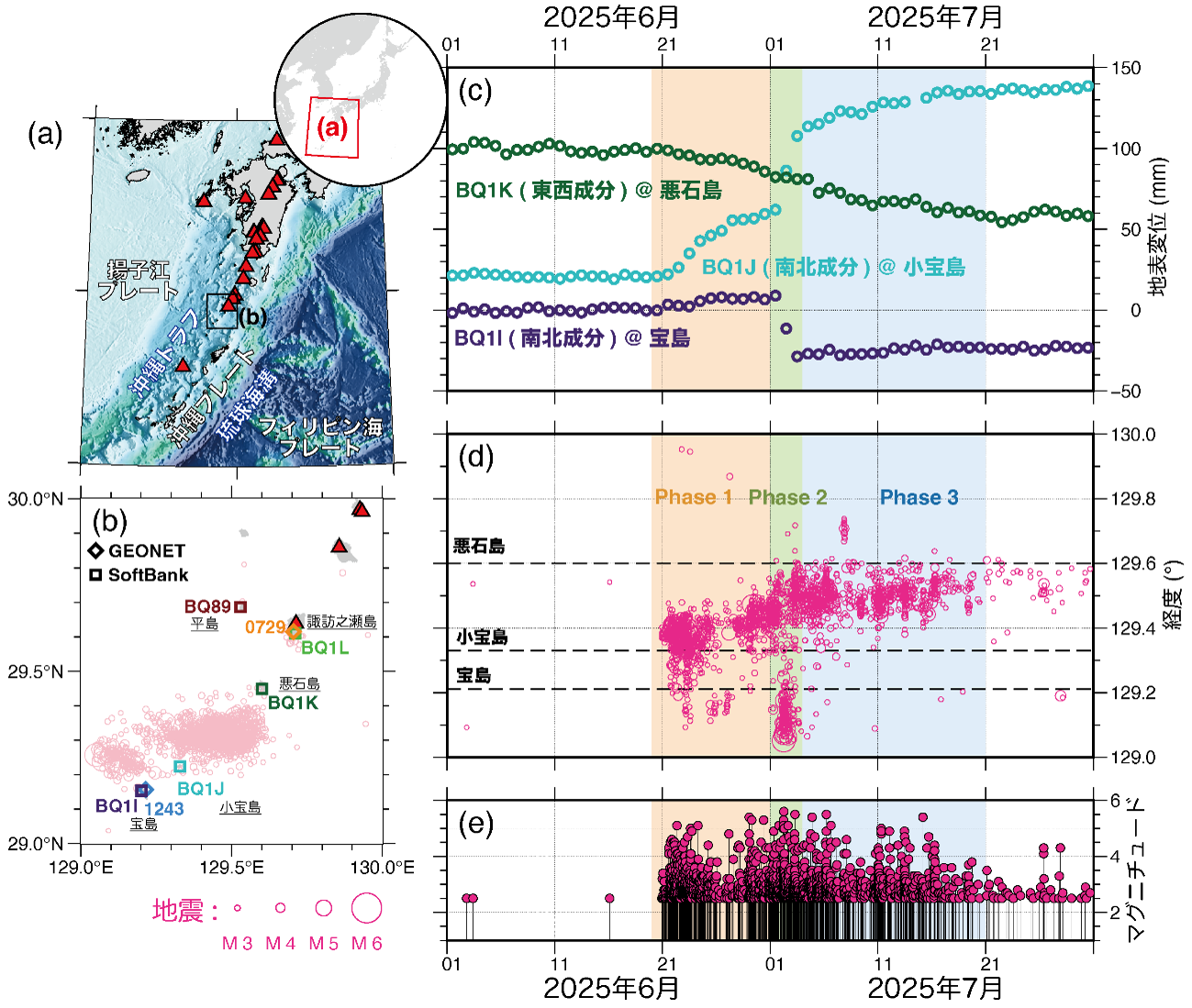
図1. (a) 解析対象地域周辺の広域地図。赤色の三角は活火山を示す。(b) 2025年6月1日から7月31日までの地震活動(桃色円)とGNSS観測局分布。ダイヤモンドは国土地理院の運用するGEONET観測局を、四角はソフトバンクの独自基準点をそれぞれ示す。(c) 宝島(BQ1I)、小宝島(BQ1J)、悪石島(BQ1K)の観測局のGNSS時系列。背景の色は地震活動と地殻変動に基づき同定した「Phase」を示す。(d) (b)に示した地震の時間-経度図。黒い破線は宝島、小宝島、悪石島のおおよその位置を示す。(e) (b)に示した地震の時間-規模図。
<関連情報>
- https://www.tohoku.ac.jp/japanese/2026/07/press20260707-01-aseismic.html
- https://link.springer.com/article/10.1186/s40623-026-02489-6
南日本、トカラ諸島沖における繰り返し発生する群発地震と一時的な地殻変動:2025年の群発地震系列からの知見 Recurrent earthquake swarms and transient crustal deformation off the Tokara Islands, southern Japan: insights from the 2025 swarm sequence
Yutaro Okada,Yusaku Ohta,Miku Ohtate,Yoshiaki Ito,Mako Ohzono,Hiroshi Yakiwara & Shigeru Nakao
Earth, Planets and Space Published:01 July 2026
DOI:https://doi.org/10.1186/s40623-026-02489-6
Abstract
Transient crustal deformation is often observed in conjunction with earthquake swarms and is attributed to aseismic processes that drive swarm activity, such as magma intrusion, fluid migration, or slow slip events. Off the Tokara Islands, along the volcanic front of the Ryukyu subduction zone in the southern Japanese Archipelago, earthquake swarms have repeatedly occurred; however, the driving mechanism of this anomalous seismicity remains unclear. Here, we investigate this mechanism through integrative analyses of Global Navigation Satellite Systems (GNSS) data from the Geospatial Information Authority of Japan and SoftBank Corp. The daily GNSS position time series at multiple stations exhibits clear transient signals that coincide with recurrent earthquake swarms. Notably, during the June–July 2025 episode, both the temporal trend and spatial pattern of the displacement changed abruptly at the onset of the secondary swarm. Motivated by these distinctive characteristics, we estimated the source models for the 2025 episode by dividing it into three phases. For all phases, the displacements calculated from rectangular faults with shear slip reproduce the observed displacements well. Vertical open cracks provide an alternative source model, but their data fit is systematically worse than that of the shear-slip models. A stacked time series of 30-s kinematic GNSS positions further suggests that the temporal relationship between aseismic deformation and seismicity can vary even within a single episode. Based on the shear-slip and open crack models for the 2025 episode, we propose two scenarios for the driving mechanisms of aseismic displacements and earthquake swarms. In both scenarios, we speculate that the supply of material from a region deeper than the aseismic source and swarm hypocenters plays a key role in generating these episodes.