2026-05-09 中国科学院(CAS)
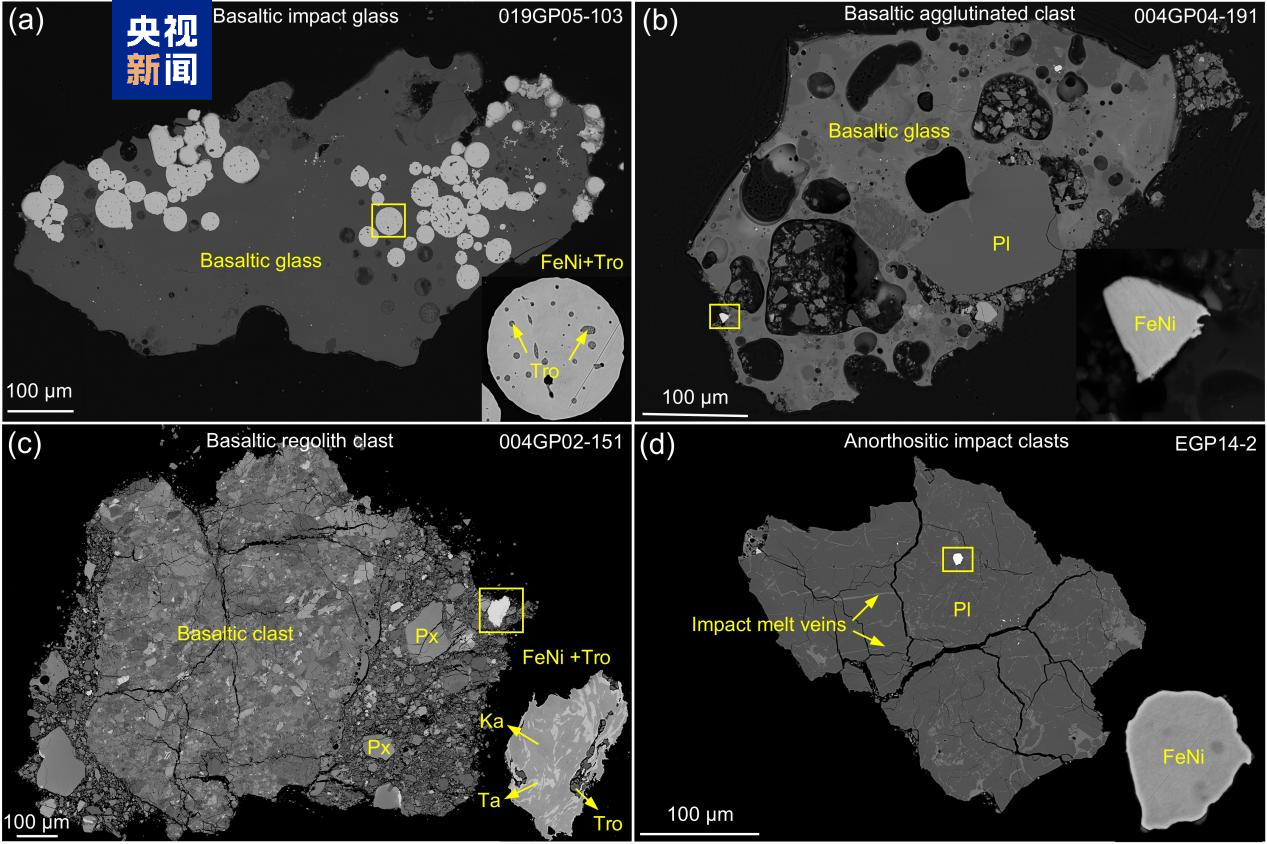
A study uncovers new insights into the history of asteroid impacts on the Earth-moon system. /CMG
<関連情報>
- https://english.cas.cn/newsroom/cas-in-media/202605/t20260509_1158641.shtml
- https://agupubs.onlinelibrary.wiley.com/doi/10.1029/2026JE009653
嫦娥6号の月面金属に記録された炭素質小惑星の後期衝突 Late Bombardment of Carbonaceous Asteroids Recorded in Chang’e-6 Lunar Metals
Xiaoying Liu, Jialong Hao, Jing Li, Heng-Ci Tian, Sen Hu, Zongyu Yue, Yi Chen, Wei Yang, Lihui Jia, Lixin Gu, Ross N. Mitchell, Douglas N. C. Lin, Yangting Lin, Xianhua Li, Fuyuan Wu
Journal of Geophysical Research:Planets Published: 21 April 2026
DOI:https://doi.org/10.1029/2026JE009653
Abstract
Asteroid impact, playing a key role in shaping the Moon, is a consequence of the orbital dynamical evolution of the Solar System. While the impact flux can be deduced from lunar craters, the impactor populations and their temporal variations remain poorly understood. We analyzed Fe-Ni metals in 40 impact clasts from the Chang’e-6 lunar soils and demonstrated that most of them are asteroidal remnants. The majority of these clasts (27 out of 40) originated from local basalt, where the asteroidal materials were accumulated after basaltic eruption at 2.8 billion years ago (Ga). The remaining 13 clasts are exotic feldspathic materials, delivered from the ancient lunar highlands, preserving asteroid remnants from ∼4.3 Ga to the present. By classifying the asteroid impactors based on the Ni, Co, P, Ir, and Au contents of the metals, we identified distinct impactor populations for the two clast types. All carbonaceous chondrite metals are exclusively found in seven of the basaltic impact clasts, providing robust evidence for a late-stage bombardment by carbonaceous asteroids. The significant increase in carbonaceous impactors can be attributed to orbital dynamical events between 4.3 and 2.8 Ga, including giant planet migration, the Yarkovsky effect, or breakup of large carbonaceous asteroids. These findings, together with the exponentially declining impact flux, imply that only a small proportion of carbonaceous asteroids were delivered to the early Earth-Moon system, and provide further constraints on the dynamical evolution of the Solar System.
Plain Language Summary
The orbital dynamic evolution of the Solar System is critical to Earth’s habitability and is largely constrained by impact fluxes recorded in lunar craters. However, the distribution of asteroid impactor types—another key parameter—remains poorly understood. Here, we analyzed individual iron-nickel metal grains in the Chang’e-6 impact clasts from two regions of different ages, to trace possible changes in the types of asteroid impactors. The data reveal a significant increase in the relative abundance of carbonaceous asteroid impactors between ∼4.3 and ∼2.8 Ga. These findings shed light on the orbital dynamics of the early Solar System, and the late bombardment of carbonaceous asteroids has important implications for the delivery of water to the early Earth.