2026-07-06 京都大学
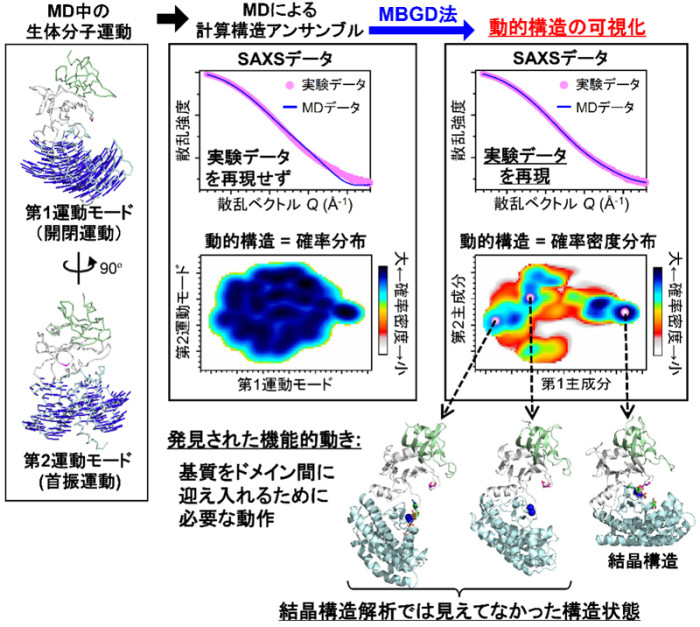
MBGD法による実験データとMDシミュレーションの統合解析:可視化されたSjGlcNKの動的構造
<関連情報>
- https://www.kyoto-u.ac.jp/ja/research-news/2026-07-06-1
- https://journals.aps.org/prresearch/abstract/10.1103/vkck-1pcm
確率分布の多様体に基づく変換:実験データから分布を再構築する逆問題への応用 Manifold-based transformation of probability distributions: Application to the inverse problem of reconstructing distributions from experimental data
Tomotaka Oroguchi, Rintaro Inoue, and Masaaki Sugiyama
Physical Review Research Published 15 June, 2026
DOI: https://doi.org/10.1103/vkck-1pcm
Abstract
Information geometry is a mathematical framework that elucidates the manifold structure of the probability distribution space (p space), providing a systematic approach to transforming probability distributions (PDs). In this study, we utilized information geometry to address the inverse problems associated with reconstructing PDs from experimental data. Our initial finding is that the Kullback-Leibler divergence, often considered nonmetric owing to its asymmetry, can serve as a valid metric under specific geometric conditions on the manifold. Based on this finding, we formulated the manifold-based gradient descent (MBGD) method, which was employed to visualize the internal structures—represented as PDs—of two types of systems: those with static constituent elements and those with dynamic state transitions. Through the application of MBGD, we successfully reconstructed the underlying PDs for both types of systems, outperforming the standard gradient descent methods that neglect the manifold structure of p space. Therefore, the present results demonstrate the essentiality of accounting for the manifold structure of p space in the inverse problems of reconstructing PDs. The ability of MBGD to accurately reconstruct PDs for systems with dynamic state transitions underscores its potential to provide valuable physical insights by visualizing internal structures.