2026-06-10 東北大学
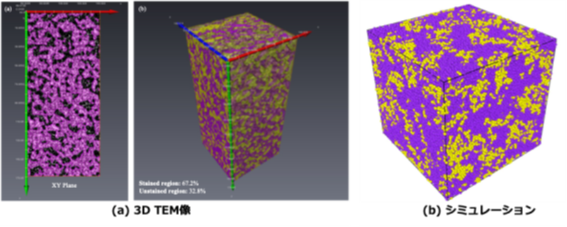
図1. シリコーンハイドロゲルの3次元共連続構造
<関連情報>
- https://www.tohoku.ac.jp/japanese/2026/06/press20260610-01-silicosim.html
- https://pubs.rsc.org/en/Content/ArticleLanding/2026/SM/D6SM00092D
両親媒性シリコーンハイドロゲルの3D形態と相選択的輸送:実験とマルチスケールシミュレーション 3D morphology and phase-selective transport in amphiphilic silicone hydrogels: experiments and multiscale simulations
Eri Ito, Yoshiaki Kawagoe and Tomonaga Okabe
Soft Matter Published:26 May 2026
DOI:https://doi.org/10.1039/D6SM00092D
Abstract
Amphiphilic bicontinuous nanophase-separated networks can, in principle, provide independent pathways for transporting hydrophobic and hydrophilic species, yet PIPS membranes still lack a tightly validated link between 3D domain connectivity, domain identity, and phase-selective transport. Here we study amphiphilic silicone hydrogels formed by PIPS from hydrophobic silicone segments and hydrophilic monomers using complementary experiments and multiscale modeling. TEM combined with Fourier analysis resolves nanoscale phase separation, and 3D TEM reconstruction supports a bicontinuous morphology in a representative ternary formulation, providing insight into domain connectivity and composition. To connect structure and function, we measure permeability trends using oxygen as a probe for silicone-rich pathways and sodium ions as a probe for the hydrophilic network, revealing composition-dependent, phase-specific transport. To rationalize morphology formation, key interaction descriptors are extracted from all-atom molecular dynamics and transferred to reactive dissipative particle dynamics simulations of PIPS, yielding domain features consistent with experiment. Finally, domain-restricted random-walk analyses capture the phase-dependent diffusion trends and show that transport selectivity cannot be explained by domain volume fraction alone; instead, pathway geometry (e.g., tortuosity), which depends on monomer identity, makes a key contribution. Together, these results establish an experiment-simulation workflow linking molecular interactions to 3D morphology and selective transport, enabling simulation-guided design of amphiphilic membranes.