2026-07-29 東京理科大学,筑波大学,横浜国立大学,科学技術振興機構
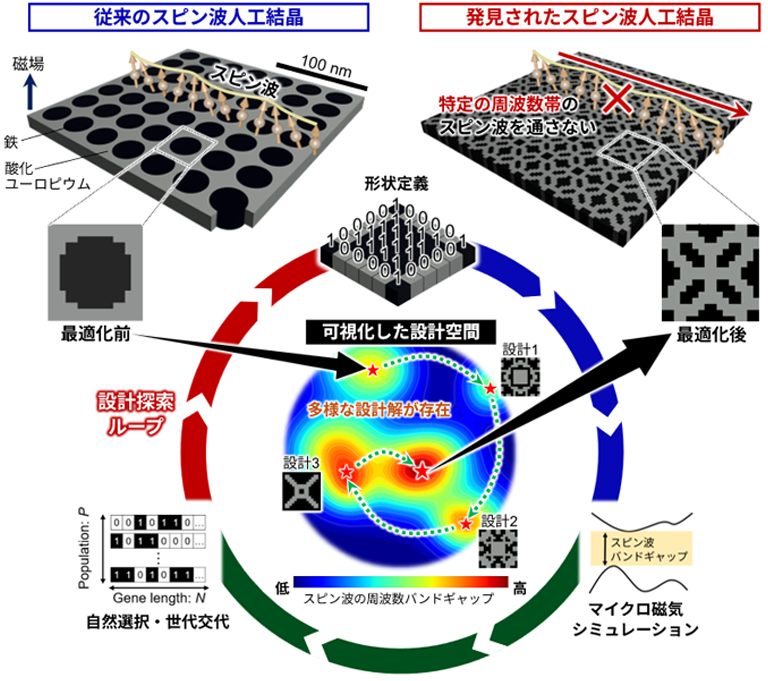
図1 スピン波バンドギャップを目的特性としたマグノニック結晶の自律設計探索。
<関連情報>
- https://www.tus.ac.jp/today/archive/20260714_3191.html
- https://onlinelibrary.wiley.com/doi/10.1002/sstr.70526
I周波数領域マイクロマグネティクスを用いたトポロジー最適化による二次元マグノニック結晶の逆設計 nverse Design of Two-Dimensional Magnonic Crystals via Topology Optimization with Frequency-Domain Micromagnetics
Ryunosuke Nagaoka, Takahiro Yamazaki, Chiharu Mitsumata, Yuma Iwasaki, Masato Kotsugi
Small Structures Published: 28 July 2026
DOI:https://doi.org/10.1002/sstr.70526
Abstract
Magnonic crystals (MCs) offer magnetic platforms for manipulating propagation characteristics of magnons, the quanta of spin waves. Due to the complex relationship between lattice geometry and magnonic band dispersion, establishing general design strategies for optimizing targeted MC properties remains challenging. This study presents a topology optimization framework for two-dimensional MCs based on binary combinatorial optimization with genetic algorithms, combined with frequency-domain micromagnetic simulations. The established design agent identifies several previously unreported MC designs, and time-domain micromagnetic simulations confirm that they exhibit up to 98% larger bandgaps than the previous best-performing design. The data-driven visualization of the design landscape further indicates that the optimization landscape becomes increasingly non-convex for higher-order bands, implying the existence of several design solutions. The framework is extensible to experimentally accessible material systems and device dimensions, providing a basis for establishing design rules for MCs.