2026-06-16 京都工芸繊維大学
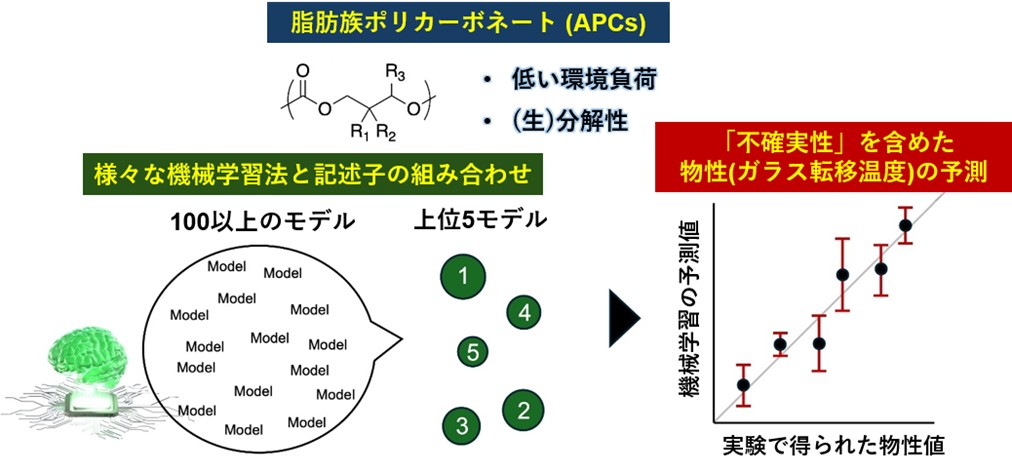
カーボンニュートラル実現への鍵となる脂肪族ポリカーボネートの物性を、
アンサンブル機械学習により「不確実性」を含めて高精度に予測
<関連情報>
- https://www.kit.ac.jp/2026/06/news260616/
- https://www.kit.ac.jp/wp/wp-content/uploads/2026/06/news260616.pdf
- https://www.nature.com/articles/s41428-026-01208-y
アンサンブル機械学習を用いた脂肪族ポリカーボネートのガラス転移温度の不確実性を考慮した予測 Uncertainty-aware prediction of the glass transition temperature of aliphatic polycarbonates using ensemble machine learning
Yoshifumi Amamoto,Ryunosuke Ito,Mikako Murakami,Kohzo Ito & Kazuki Fukushima
Polymer Journal Published:16 June 2026
DOI:https://doi.org/10.1038/s41428-026-01208-y
Abstract
Sustainable polymers are often designed to be degradable or recyclable via low-energy, low-CO₂-emission pathways while demonstrating high physical properties comparable to those of conventional plastics. Aliphatic polycarbonates (APCs), studied as functionalized degradable polymers, are promising candidates for use as sustainable materials. However, enhancing their physical properties remains essential. Polymer properties depend on various factors, including chemical structure, molecular weight and its distribution, branching, higher-order structures, and thermal history, and are therefore not uniquely determined. Machine learning models are powerful tools for predicting polymer properties with associated uncertainty, particularly for polymers absent from open datasets. Herein, we investigate uncertainty-aware predictions of the glass transition temperature (Tg) of APCs using ensembles of multiple molecular descriptors and machine learning methods. The Tg data for more than 50 APCs were collected from previous experimental studies. Prediction models for Tg were constructed using more than 100 combinations of molecular descriptors and machine learning algorithms based on datasets of common polymers. The top five models, selected by coefficients of determination, exhibited moderate predictive performance for APCs. The mean values and standard deviations of the predictions obtained from the top five models provide Tg predictions with quantified uncertainty. This ensemble-based framework will be extended to uncertainty-aware prediction of various polymer properties.