2026-07-29 東北大学
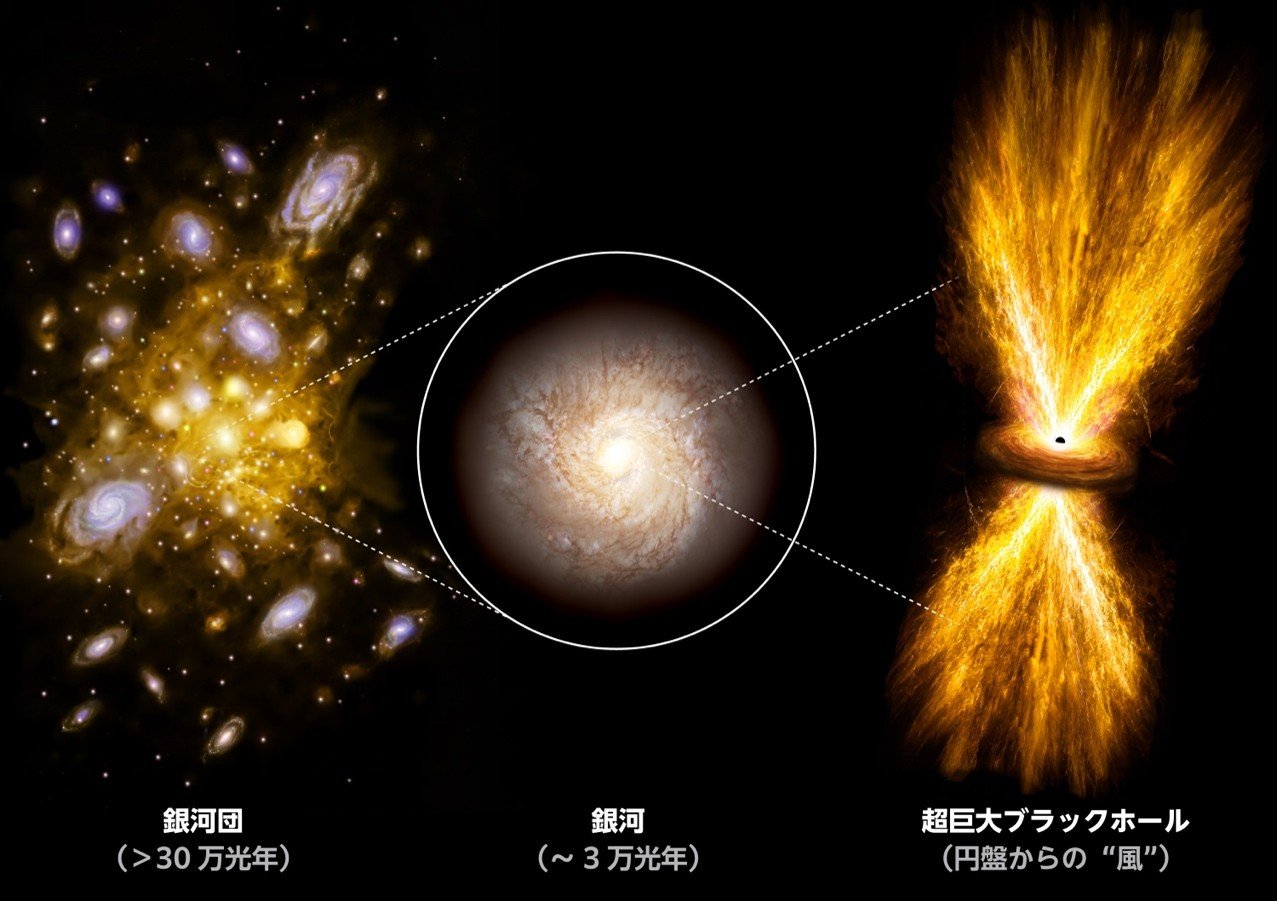
図1. 宇宙における銀河団(銀河の集団)から単一の銀河、その中心に存在する超巨大ブラックホールへと至る階層構造の模式図。ブラックホールは銀河の半径に比べて約1億倍以上も小さいが、銀河の中心で重要な役割を担っている。(クレジット:東北大学)
<関連情報>
- https://www.tohoku.ac.jp/japanese/2026/07/press20260729-01-vigorous.html
- https://www.nature.com/articles/s41550-026-02939-x
銀河団中心部におけるクエーサーモードフィードバックによって引き起こされる激しい乱流 Vigorous turbulence driven by quasar-mode feedback in a cluster core
Satoshi Yamada,Shutaro Ueda,Hirofumi Noda,Yutaka Fujita,Misaki Mizumoto,Kentaro Nagamine,Claudio Ricci,Shoji Ogawa,Taiki Kawamuro,Shinya Yamada,Yuichi Terashima & Yoshihiro Ueda
Nature Astronomy Published:28 July 2026
DOI:https://doi.org/10.1038/s41550-026-02939-x
Abstract
Quasars are among the most luminous objects. They are powered by accretion onto supermassive black holes. They are thought to impact cosmological evolution primarily through energetic winds, known as quasar-mode feedback, yet the efficiency and spatial extent of this process remain poorly constrained. Here we present X-Ray Imaging and Spectroscopy Mission (XRISM) observations of H1821+643—the nearest galaxy cluster with a central quasar (redshift z = 0.297)—which was a rare opportunity to directly probe quasar-mode feedback in the intracluster medium. High-resolution spectroscopy reveals exceptionally broadened Fe XXV emission lines from the intracluster medium, with a velocity dispersion of approximately 300 km s−1, far exceeding values observed in nearby cluster cores. These lines originate predominantly at radii of 20–100 kpc from the centre. Assuming that turbulence from a quasar-driven shock led to the broadening of the lines, the energy injected by the quasar beyond galactic scales (≳20 kpc) is estimated to be ≳1–10% of its radiative energy. Notably, this feedback efficiency exceeds previous multiwavelength estimates by orders of magnitude (≲0.01%) and reaches the levels required by the latest cosmological hydrodynamical simulations. This finding of vigorous turbulence indicates that quasar-mode feedback plays a central role in regulating galaxy and cluster evolution at high redshift.