2026-06-05 京都大学
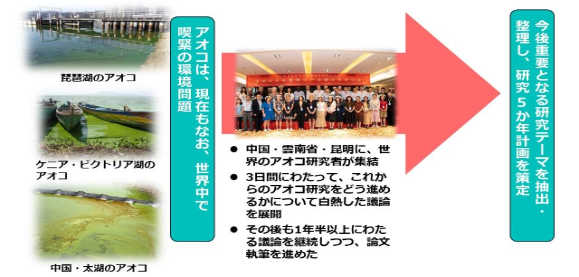
世界中の富栄養化湖沼で発生するアオコ問題に対して、今後の5年間にわたってどのような研究を進めるべきか、世界12か国から23人の研究者が集まって対面で議論し、論文として発表した。
・イラスト/作成:中野伸一(生態学研究センター)
・撮影:アオコ写真(中野伸一)、集合写真(Xuexiu Chang/University of Windsor)
<関連情報>
- https://www.kyoto-u.ac.jp/ja/research-news/2026-06-05-2
- https://www.cell.com/trends/ecology-evolution/abstract/S0169-5347(26)00085-6
有毒アオコのブルームについて、研究の今後を見通す Scanning the horizon for harmful cyanobacterial blooms
Xuexiu Chang (常学秀) ∙ Hugh J. MacIsaac ∙ Ingrid Chorus ∙ … ∙ Boqiang Qin (秦伯强) ∙ Lewis Sitoki ∙ Runbing Xu (徐润冰)
Trends in Ecology & Evolution Published:June 2, 2026
DOI:https://doi.org/10.1016/j.tree.2026.04.012
Highlights
Climate change and nutrient pollution are intensifying toxic cyanobacterial blooms, exacerbating risks to freshwater ecosystems, animal health, and human well-being.
Why and when blooms turn toxic remains unpredictable, but advances in genomics, metabolomics, and machine learning now offer new tools to address this challenge.
Twenty-three experts from 12 countries identified four research priorities: drivers of toxigenic dominance, toxin biosynthesis regulation, health risks beyond known cyanotoxins, and ecosystem-scale controls across understudied habitats.
Innovations in mechanistic and ecosystem-informed approaches will improve the predictability and efficacy of managing cyanobacterial blooms in a rapidly changing world.
Abstract
Harmful cyanobacterial blooms are increasing worldwide, threatening freshwater ecosystems, animal health, and human well-being. To guide research needed for effective prediction, prevention, and management, we identify four priorities: understanding eco-evolutionary and phylogeographic drivers that promote toxigenic cyanobacterial genotypes; resolving molecular and environmental controls on cellular cyanotoxin biosynthesis; integrating microbiome science with multiomics and epidemiology to assess associated health risks beyond cyanotoxins; and quantifying ecosystem-scale bottom-up and top-down controls in understudied settings, particularly tropical and benthic habitats. New research tools for addressing these priorities enable elucidating the mechanistic basis for anticipating cyanobacterial blooms and provide the understanding needed for their control in a rapidly changing world.