2026-07-10 北海道大学,パシフィックコンサルタンツ株式会社,鉄道建設・運輸施設整備支援機構
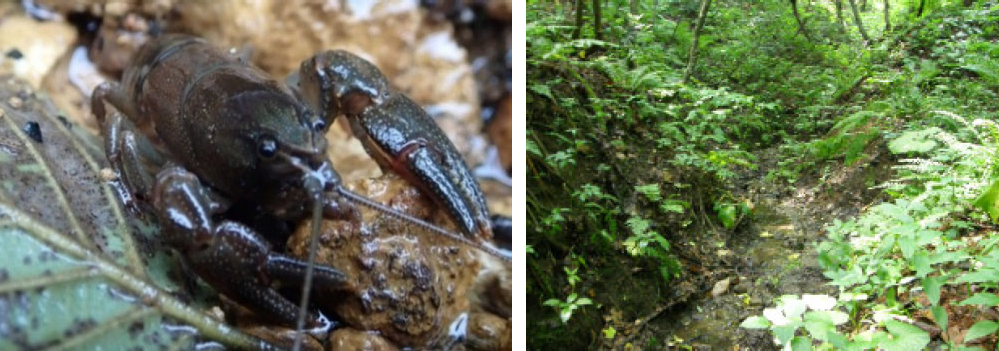
絶滅危惧種ニホンザリガニと源頭部の生息地。
<関連情報>
- https://www.hokudai.ac.jp/news/2026/07/post-2349.html
- https://academic.oup.com/jcb/article-abstract/46/3/ruag035/8725984
北海道新幹線事業に伴う大規模環境アセスメントが明らかにした、未攪乱な森林河川における絶滅危惧種ニホンザリガニの高い生息率 Extensive environmental assessments for the national Shinkansen railroad project reveal high occurrence of the endangered Japanese crayfish, Cambaroides japonicus (De Haan, 1841) (Decapoda: Astacidea: Cambaroididae), in undisturbed forest streams
Wei Jia,Tadashi Kawai,Takeshi Ejima,Naoya Kusuda,Tsuyoshi Urushihara,Kousuke Ikeda,Itsuro Koizumi
Journal of Crustacean Biology Published:07 July 2026
DOI:https://doi.org/10.1093/jcbiol/ruag035
Abstract
Freshwater crayfishes are among the most imperiled animal groups worldwide, with many species experiencing rapid local extinctions due to climate change, habitat modification, and biological invasions. The Japanese crayfish, Cambaroides japonicus (De Haan, 1841), the only native crayfish in Japan, is a relict and endemic species of high conservation concern. Although recent reports have suggested ongoing local extinctions, the species persists in numerous habitats, predominantly in headwater streams. Yet, quantitative data at broad spatial scales remain scarce, limiting our understanding of extinction patterns and the ecological conditions that support population persistence. We analyzed extensive environmental assessment data collected for the national Shinkansen Hokkaido railway project in southern Hokkaido, Japan. Because the railway route primarily traverses undisturbed forested areas, distribution data enabling quantitative assessment of the occurrence status of Cambaroides japonicus under near-natural conditions was collected. We employed a two-scale modeling approach: a microhabitat analysis to identify site-specific drivers of abundance, and a macrohabitat analysis using to assess landscape-scale land use. Our results demonstrated a high presence rate of 94.4% across the study area. At the microhabitat scale, the stream width and the presence of large substrate significantly affected catch per unit effort (CPUE). Macro-habitat modeling revealed that total forest area was a significant positive predictor of both presence and CPUE, suggesting that Japanese crayfish can thrive in almost all small headwater streams when shielded from anthropogenic pressures and the introduction of invasive crayfishes. The study demonstrates the success of a tripartite framework connecting developers, consultants, and academics to repurpose infrastructure data for conservation science. Our results highlight the importance of protecting undisturbed forested catchments for this native species.