
2026-05-13 三重大学
<関連情報>
- https://www.mie-u.ac.jp/news/topics/2026/05/post-4110.html
- https://www.mie-u.ac.jp/news/topics/bc12c12fcc3b4e9c924adbcb0130ccc6.pdf
- https://www.sciencedirect.com/science/article/abs/pii/S0025326X26004066
植食性貝類のプラスチック侵食能力は歯舌の形態,化学的・機械的特性によって決定されるRadular morphology, elemental composition, and mechanical properties determine the plastic-eroding ability of molluscan grazers
Aoi Nakano, Shouji Houki, Rei Yamashita, Tomohiko Kawamura
Marine Pollution Bulletin Available online: 25 March 2026
DOI:https://doi.org/10.1016/j.marpolbul.2026.119619
Highlights
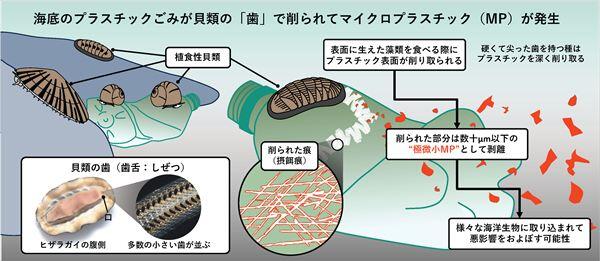
- Molluscan grazers erode the surfaces of multiple types of plastic.
- Hard mineral–enriched radular teeth enable erosion of even rigid plastic materials.
- Sharp-tipped radular cusps greatly increase the degree of plastic surface damage.
- Grazing produces extremely fine microplastics, often smaller than several tens of micrometers.
- Molluscan bioerosion represents an overlooked biological source of benthic microplastics.
Abstract
Microplastics (MPs) have recently attracted considerable attention as a major marine pollutant capable of infiltrating the digestive tracts, tissues, and even cells of marine organisms, potentially causing severe biological impacts. To date, the primary drivers of MP generation in marine environments have been regarded as abiotic factors such as wind, waves, and ultraviolet radiation, with coastal and surface waters recognized as the main source areas. In benthic environments, however, the activities of bioeroding organisms, particularly benthic animals, may also contribute to MP production. Molluscan grazers inhabiting rocky substrates use the radula to scrape algae and sediments from surfaces. Thus, when plastic debris accumulates on the seafloor, molluscan grazing activity may erode plastic surfaces and generate MPs. In this study, we examined four molluscan grazers—two chitons, one limpet, and one topshell—to evaluate whether their feeding activities could erode five types of plastics. We also investigated the relationship between the erosion capacity and the morphology, elemental composition, and mechanical properties of the radular teeth using scanning electron microscopy (SEM), energy-dispersive X-ray spectroscopy (EDX), and nanoindentation analyses. The results showed that all tested plastics were eroded by grazing activity. Species with radular teeth enriched with hard materials such as iron and silica were capable of eroding even hard plastics, whereas those with sharp-tipped teeth caused more pronounced surface damage. Most MPs produced by these grazers were smaller than several tens of micrometers, indicating that such fine particles could pose ecological risks to a wide range of marine organisms.

、令和7年4月12日発生)](https://tiisys.com/wp-content/uploads/2026/05/スクリーンショット-2026-05-28-185151.png "個人グラザー・ディルクスDG-400(動力滑空機、単座)の事故[着陸時の機体損傷](北海道北見市 北見地区農道離着陸場(スカイポートきたみ)、令和7年4月12日発生)")