2026-06-04 米国国立標準技術研究所(NIST)
◆研究では、高エネルギーレーザー照射によって材料表面に極めて短時間の高温・急冷環境を作り出し、通常は混ざりにくい元素同士を局所的に均一混合できることを示した。この過程では、レーザーによる急速な溶融と凝固が微細組織の形成を促進し、従来法では得にくい新たな組成や特性を持つ合金の創製が可能となる。研究チームは、この技術が高スループット材料探索と相性が良く、先端製造や材料開発の高速化に貢献すると期待している。特に、航空宇宙、エネルギー機器、電子部品向けの高性能材料開発や、積層造形(3Dプリンティング)プロセスへの応用が有望である。
◆今回の成果は、レーザー加工を単なる製造技術ではなく、新材料創製のための革新的な材料設計ツールとして活用できる可能性を示した。
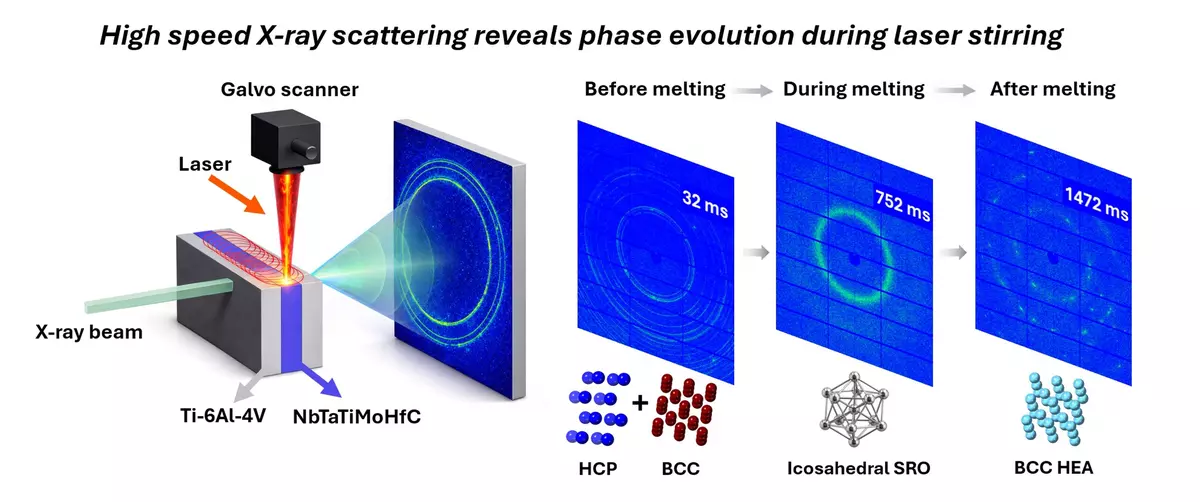
One of the most challenging parts of this research was developing a way to see what was happening inside the metal on the atomic level as it cooled. For this research project, NIST pioneered a way to do just that using X-ray diffraction, a method where X-rays are passed through the metal, bouncing off some of the atoms. Then the X-ray patterns on the other side are analyzed to determine how the atoms are arranged. Credit: F. Zhang/NIST
<関連情報>
- https://www.nist.gov/news-events/news/2026/06/nist-researchers-discover-new-way-whisk-alloys-together-lasers
- https://www.sciencedirect.com/science/article/abs/pii/S2214860426000278
楕円走査によるレーザー攪拌により、積層造形におけるオンデマンド合金化が可能になる Laser stirring with elliptical scanning enables on-demand alloying in additive manufacturing
Ho Yeung, Jordan Weaver, Andre Ponsot, Junaid Dar, Yisong Zhang, Dong Lin, Andrew Chuang, Michael C. Gao, Fan Zhang
Additive Manufacturing Available online: 30 January 2026
DOI:https://doi.org/10.1016/j.addma.2026.105101
Abstract
Achieving homogeneous mixing of dissimilar elements is critical for additive manufacturing (AM) of metals, particularly for in-situ alloying and high-entropy alloys (HEAs), where compositional uniformity directly affects phase formation, mechanical properties, and long-term performance. However, mixing during AM represents a challenge due to the limited melt pool convection, i.e., passive Marangoni flow. In this work, we present laser stirring via an elliptical scan strategy as a scan-path-driven method to actively modulate melt pool dynamics and enhance elemental mixing. We validate this method using a sandwich sample of dissimilar Ti-6Al-4V and a refractory HEA with significant mismatches in melting point, density, viscosity, solubility, and diffusivity. We performed in-situ high-speed diffraction measurements to reveal the phase evolution during laser stirring and used post-build scanning electron microscopy measurements for detailed chemical and microstructural analysis. Our results convincingly show that laser stirring leads to improved elemental mixing, enabling the formation of a single-phase body-centered cubic HEA. This study establishes a new, scalable, and tunable pathway for reliable in-situ alloying, opening possibilities for on-demand production of novel alloys and compositionally gradient materials directly from dissimilar feedstocks.