2026-06-04 ペンシルベニア州立大学(Penn State)
◆研究チームは、NASAのハッブル宇宙望遠鏡による紫外線観測データを解析し、極端な速度を持つガス流を特定した。この種のアウトフローは、ブラックホールが周囲の銀河環境へエネルギーや物質を供給する「AGNフィードバック」の重要な証拠と考えられている。観測された速度は従来の紫外線風の記録を大きく更新し、これまで主にX線観測で見つかっていた超高速アウトフローとの関連性を示唆する。
◆研究成果は、超大質量ブラックホールの成長過程や銀河進化への影響を理解する上で重要な手掛かりとなり、ブラックホール周辺での高エネルギー物理現象の解明に貢献すると期待されている。
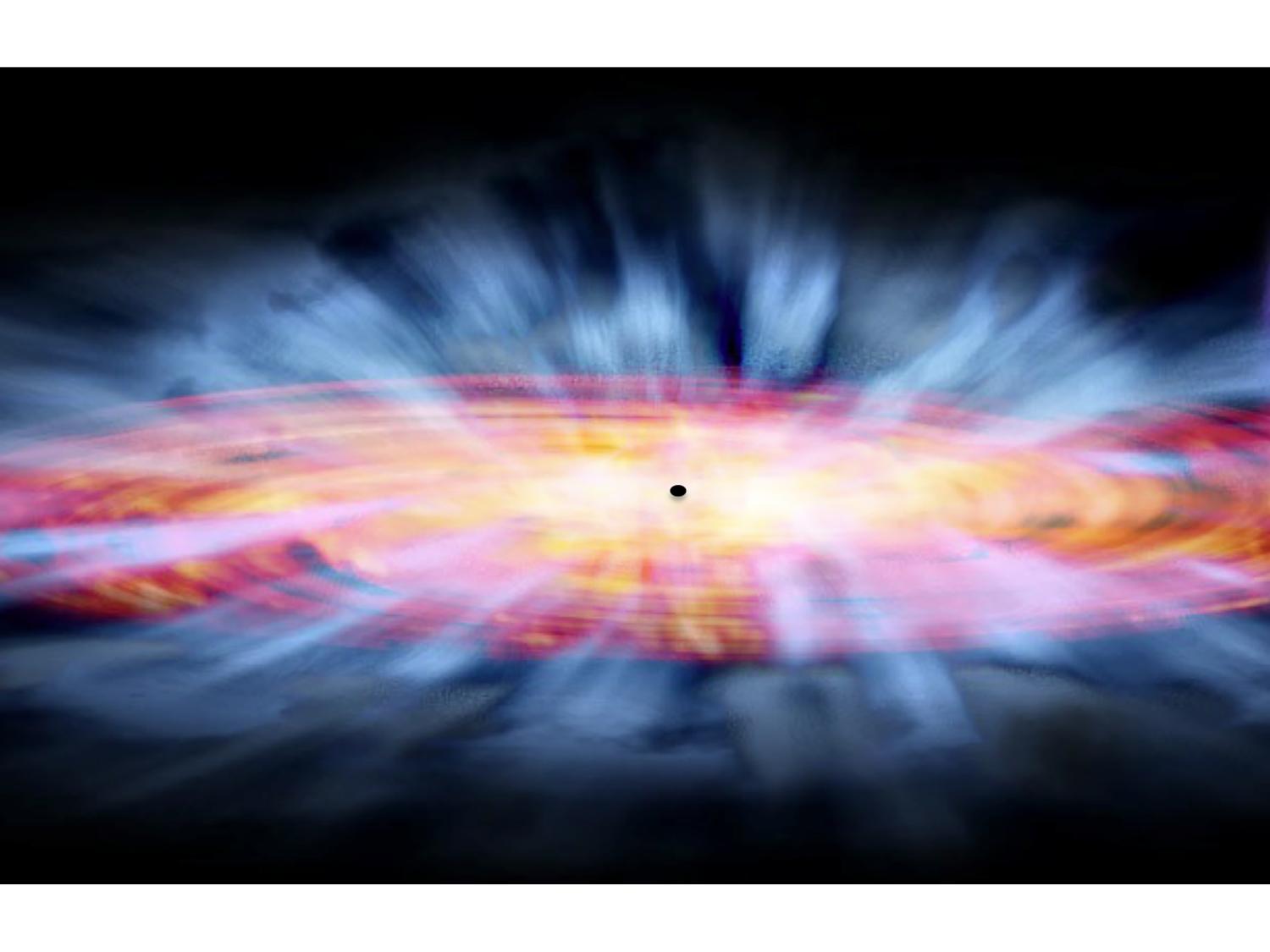
The black dot in the center of this artist’s impression represents the supermassive black hole at the center of the quasar. The red-and-yellow spiral surrounding it shows the accretion disk of hot gas falling into the black hole. Some of this gas is ejected as the quasar’s wind, which is shown in light blue. The size of the accretion disk shown is comparable to the size of our solar system. Credit: NASA/CXC/M. Weiss, Nahks Tr’Ehnl, Nurten Filiz Ak. All Rights Reserved.
<関連情報>
- https://www.psu.edu/news/eberly-college-science/story/fastest-ultraviolet-wind-detected-black-hole-constellation-pegasus
- https://iopscience.iop.org/article/10.3847/1538-4357/ae5f94
ワイルド・スピードファミリーの新たなメンバー:高光度クエーサーにおける相対論的かつ時間変動する紫外線流出 A New Member of the Fast and Furious Family: A Relativistic and Time-variable UV Outflow in a Luminous Quasar
Lucas M. Seaton, Patrick B. Hall, Liliana Flores, Paola Rodríguez Hidalgo, Marianna Veltri, Zezhou Zhu, Javier Serna, W. Niel Brandt, Scott Anderson, Roberto J. Assef,…
The Astrophysical Journal Published: 2026 June 4
DOI:10.3847/1538-4357/ae5f94
Abstract
We report the fastest quasar outflow first detected in the ultraviolet, via variable C iv and Si iv absorption at outflow velocities −77,000 km s−1 to at least −90,000 km s−1, in the radio-quiet quasar SDSS J231854.31+243954.2 (J2318). J2318 is a weak-lined quasar in the rest-frame ultraviolet, but Gemini GNIRS spectroscopy reveals an Hα redshift of z = 2.6781 ± 0.0004. A 20 yr photometric time series shows peak-to-peak variability of 0.5 mag in the g band. The C iv outflow strengthened monotonically over three epochs spanning ∼2.2 rest-frame years. The existence of such a high-velocity outflow implies that models of quasar outflows must be able to either accelerate gas to 0.3c while still preserving C iv and Si iv ions, or enable the formation of C iv and Si iv ions in gas, which has been accelerated to 0.3c. Virial estimates reveal a black-hole mass of 1.65 × 10⁹M⊙, which leads to an Eddington luminosity and Eddington ratio of 2.4 × 1047 erg s−1 and 0.45, respectively. Using very conservative assumptions, the UV-absorbing outflow alone has an estimated mass loss of >0.82 M⊙ yr−1 and a kinetic luminosity ratio Lkin/Lbol ≥ 0.75%. The lower limit is just above the threshold usually cited for significant feedback on the host galaxy. Comparison to PDS 456, the only other known quasar with a UV-absorbing outflow at 0.3c, suggests that the true M・and Lkin/Lbol could be up to 2 orders of magnitude larger.