
2026-014-16 中国科学院(CAS)
<関連情報>
- https://english.cas.cn/newsroom/research-news/202604/t20260420_1157555.shtml
- https://www.nature.com/articles/s41565-026-02147-8
生物学的イオンチャネルに着想を得た膜を用いた、多用途な重金属イオン分離 Versatile heavy metal ion separation via biological ion-channel-inspired membranes
Yongye Zhao,Hongfei Gao,Lei Yu,Qi Li,Chaoxu Li,Lei Jiang & Jun Gao
Nature Nanotechnology Published:16 April 2026
DOI:https://doi.org/10.1038/s41565-026-02147-8
Abstract
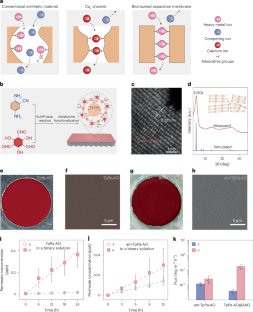
Solvent extraction and adsorption methods are predominantly used to extract heavy metal ions by binding them selectively. However, these methods require excessive chemical use and cause environmental problems. The membrane separation method avoids these problems but remains poorly compatible with heavy metal ions. In nature, biological CaV channels allow selectively bound ions (Ca2+) to rapidly and selectively permeate by exploiting the repulsive interactions between single-file ions and the anomalous mole fraction effect. Here, inspired by these channels, we demonstrate a general strategy that can transform adsorptive materials into separation membranes for heavy metal ion separation. The membranes consist of channels that can adsorb target ions in a single file. Using uranium-adsorption channels, uranium separation via the membrane was achieved, demonstrating a uranium/vanadium selectivity of 734 in real seawater and a throughput far exceeding that of previous materials. This strategy is further generalized to the separation of rare earth metals, copper and gold. Moreover, this strategy unifies the adsorption and membrane separation methods, and can also transform separation membranes to adsorbents, showing notably enhanced capacity and selectivity by rejecting the entering of competing ions, reducing the environmental impact of the adsorption method.

