2026-04-16 中部大学
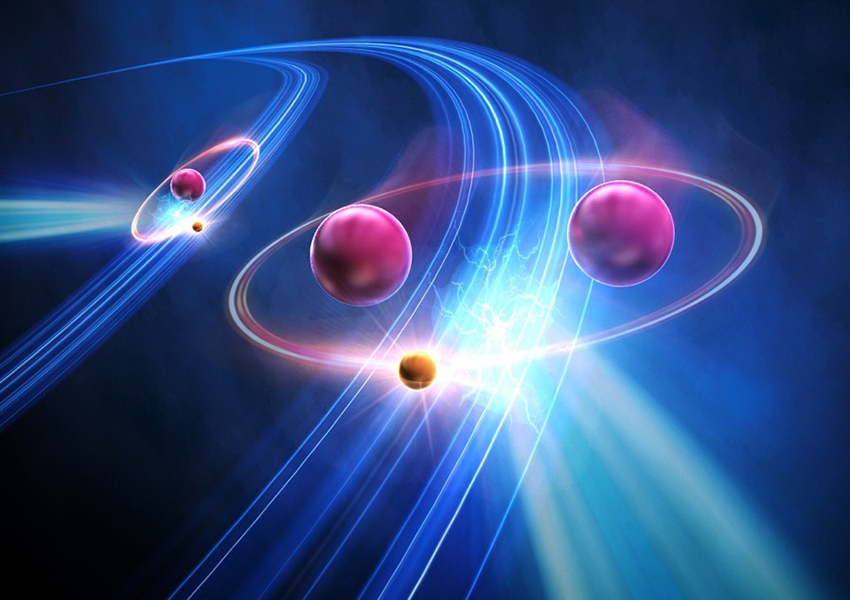
µCF反応過程におけるミュオン分子とミュオン原子からのX線放出のイメージ
<関連情報>
ミューオン触媒核融合に不可欠な共鳴状態にあるミューオン分子の直接観測 Direct observation of muonic molecules in resonance states critical to muon catalyzed fusion
Y. Toyama, T. Azuma, D. A. Bennett, W. B. Doriese, […] , and T. Yamashita
Science Advances Published:15 Apr 2026
DOI:https://doi.org/10.1126/sciadv.aed3321
Abstract
Muon catalyzed fusion (μCF) is a plasma-free process in which the formation of muonic hydrogen molecules precedes and enables fusion between their constituent nuclei. Despite decades of study, the reaction dynamics of μCF remain elusive. Recent theories predict that resonance states of the muonic molecules play a key role and that these states can be probed using x-ray techniques. Using an array of transition-edge sensor microcalorimeters with 10-fold improved energy resolution compared to conventional silicon detectors, we observed x-rays from resonance states of muonic deuterium molecules despite an intense background. The spectrum is well explained by high-precision calculations incorporating the vibrational states. This work identifies the long-overlooked resonance state pathway as crucial in μCF and provides the direct evidence of the efficient muonic molecular formation.