2026-04-16 中国科学院(CAS)
<関連情報>
- https://english.cas.cn/newsroom/research-news/202604/t20260415_1156331.shtml
- https://www.nature.com/articles/s41477-026-02263-2
植物の蒸散に最適な温度は、光合成に最適な温度よりも高い Higher optimal temperature for vegetation transpiration than for photosynthesis
Haoyu Xia,Fangyue Zhang,Philippe Ciais,Paul C. Stoy,Josep Peñuelas,Xu Lian,Ying-Ping Wang,David Makowski,Yiqi Luo,Shuli Niu,Guirui Yu,Jing Huang,Xiang Wang,Einara Zahn & Zheng Fu
Nature Plants Published:15 April 2026
DOI:https://doi.org/10.1038/s41477-026-02263-2
Abstract
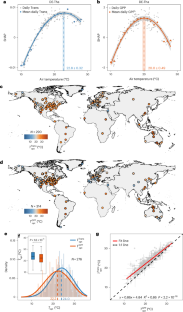
Plants assimilate carbon through photosynthesis (gross primary productivity, GPP) while losing water via transpiration (Trans), with both processes responding nonlinearly to temperature. Although the air temperature optimum of GPP (TGPPopt) is well studied, the thermal response of Trans (TTransopt) remains unknown. Here, using global eddy covariance observations and sap flow measurements along with simulations from an Earth system model, we find that TTransopt is consistently higher than TGPPopt across biomes and climates, indicating greater heat tolerance in Trans. Despite a strong correlation, their divergence suggests carbon uptake is more vulnerable to warming than water loss. Machine learning identifies maximum air temperature as the key driver of both optima, while their difference (△Topt) is associated with vegetation water content. The Earth system model predicts spatial patterns ofTTransopt and that TGPPopt align with observations, but the model significantly underestimates the magnitudes TTransopt of , TGPPopt and △Topt. These results reveal a critical decoupling of carbon–water coordination under heat stress, with ecosystems sustaining Trans beyond TGPPopt to cool leaves, but ultimately reducing Trans to conserve water.