
2024-08-06 カーディフ大学
<関連情報>
- https://www.cardiff.ac.uk/news/view/2833420-using-small-black-holes-to-find-big-black-holes
- https://www.nature.com/articles/s41550-024-02338-0
大質量ブラックホール連星が近隣のデシヘルツ重力波源に与える痕跡 Imprints of massive black-hole binaries on neighbouring decihertz gravitational-wave sources
Jakob Stegmann,Lorenz Zwick,Sander M. Vermeulen,Fabio Antonini & Lucio Mayer
Nature Astronomy Published:05 August 2024
DOI:https://doi.org/10.1038/s41550-024-02338-0
Abstract
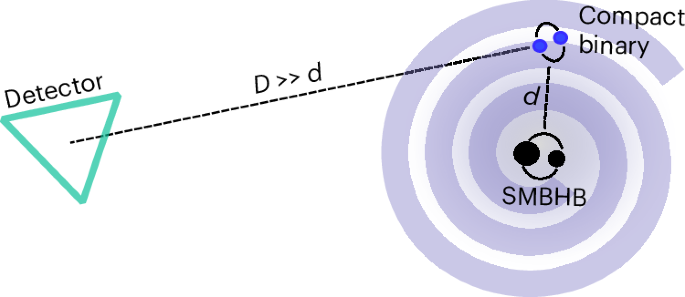
The most massive black holes in our Universe form binaries at the centre of merging galaxies. The recent evidence for a gravitational-wave (GW) background from pulsar timing may constitute the first observation that these supermassive black-hole binaries (SMBHBs) merge. Yet, the most massive SMBHBs are out of reach of interferometric GW detectors and are exceedingly difficult to resolve individually with pulsar timing. These limitations call for unexplored strategies to detect individual SMBHBs in the uncharted frequency band ≲10−5 Hz to establish their abundance and decipher the coevolution with their host galaxies. Here we show that SMBHBs imprint detectable long-term modulations on GWs from stellar-mass binaries residing in the same galaxy at a distance d ≲ 1 kpc. We determine that proposed decihertz GW interferometers sensitive to numerous stellar-mass binaries could uncover modulations from ~O(10−1–104) SMBHBs with masses ~O(107–108) M⊙out to redshift z ≈ 3.5. This offers a unique opportunity to map the population of SMBHBs through cosmic time, which might remain inaccessible otherwise.

