2026-04-16 ミュンヘン大学(LMU)
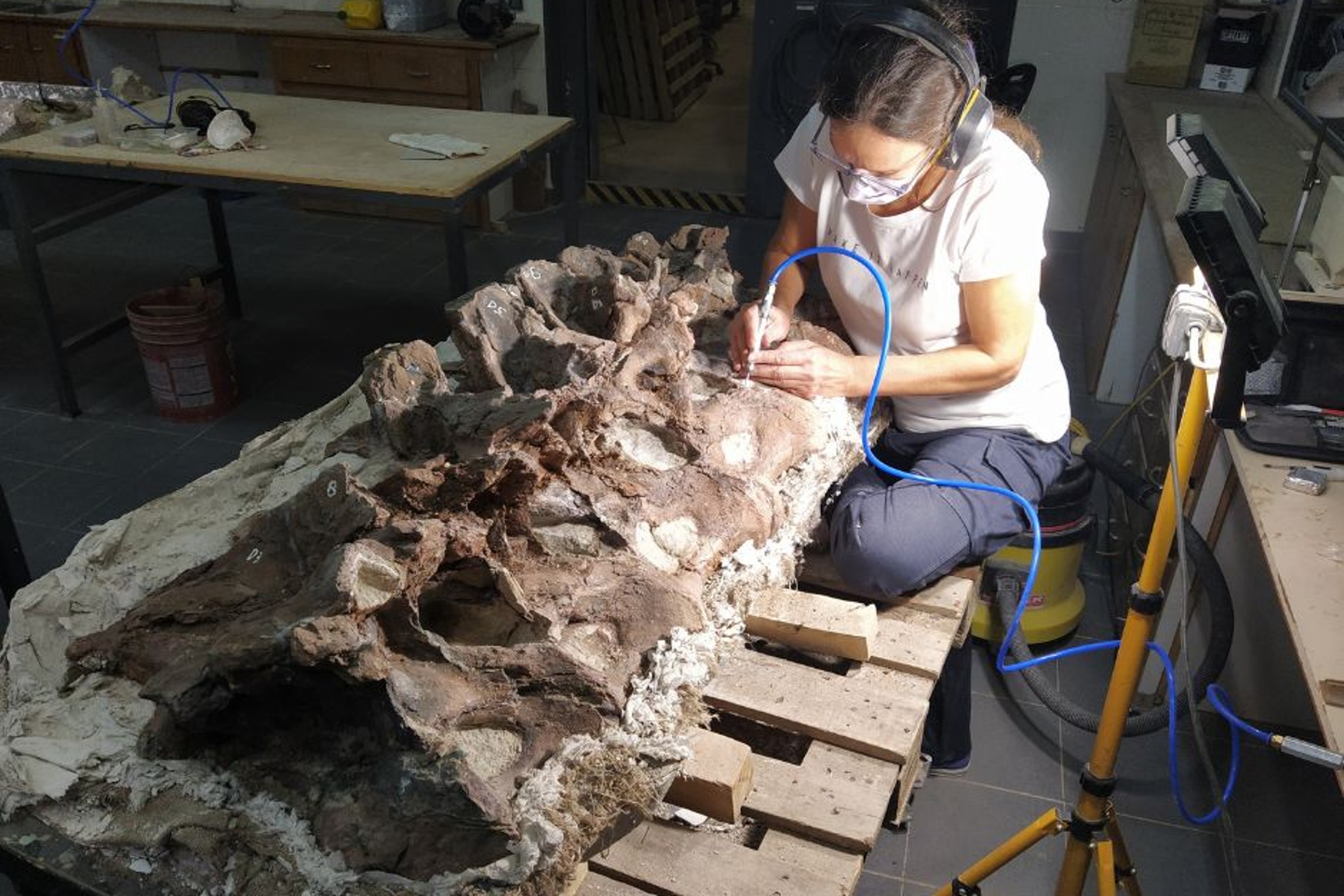
Bicharracosaurus vertebrae being prepared at the Egidio Feruglio Paleontological Museum in Trelew, Argentina. | © Amalia Villafañe
<関連情報>
- https://www.lmu.de/en/newsroom/news-overview/news/palaeontologists-discover-new-long-necked-dinosaur-in-patagonia-dd830393.html
- https://peerj.com/articles/20945/
アルゼンチンの後期ジュラ紀カニャドン・カルカレオ層から発見された新種のマクロナリアン(恐竜類、竜脚類)であるビチャラコサウルス・ディオニデイ(Bicharracosaurus dionidei, gen. et sp. nov.)と、マクロナリアンの初期進化における問題点 Bicharracosaurus dionidei, gen. et sp. nov., a new macronarian (Dinosauria, Sauropoda) from the Late Jurassic Cañadón Calcáreo Formation of Argentina and the problematic early evolution of macronarians
Alexandra Reutter, José Luis Carballido,, Guillermo José Windholz,, Diego Pol,, Oliver W.M. Rauhut
PeerJ Published:April 16, 2026
DOI:https://doi.org/10.7717/peerj.20945
Abstract
Our understanding of Late Jurassic sauropod faunas heavily relies on the fossil record of the northern hemisphere. During the last two decades, paleontological fieldwork in the Oxfordian-Kimmeridgian Cañadón Calcáreo Formation of Argentina has yielded several sauropod remains. Here we present a new taxon, Bicharracosaurus dionidei gen. et sp. nov., represented by a partial vertebral column and a fragment of the ilium. Anatomical as well as histological evidence suggest that the new specimen represents an adult individual. The posterior dorsals of Bicharracosaurus show great similarity with isolated mid- to posterior dorsal vertebrae previously referred to a diplodocid (MPEF-PV 1324) from the same formation. Some characters that supported a diplodocid position of the isolated vertebrae (pleurocoels with anteroventral fossa, dorsal margin of the pleurocoel angular and at the level of the neural canal) are also present in Bicharracosaurus. The phylogenetic position of Bicharracosaurus was tested using two recent datasets that include a large sample of basal eusauropods and basal neosauropods. The overall evidence supports a position of Bicharracosaurus within Macronaria with several analyses and diagnostic characters suggesting brachiosaurid affinities. Given the incomplete nature of the isolated vertebrae MPEF-PV 1324, their position is unstable across several analyses, but they show close affinities with either Bicharracosaurus or Diplodocidae. Despite the similarities between Bicharracosaurus and Tehuelchesaurus benitezii, a macronarian from the same formation, only in some of the phylogenetic results these two species were recovered as closely related, whereas in most analyses, Tehuelchesaurus formed a clade with Janenschia robusta as basal macronarians or non-neosauropod eusauropods. In addition, several diagnostic characters of Bicharracosaurus are absent in Tehuelchesaurus and vice versa. Our results also show that other putative macronarian taxa have incongruent positions depending on the dataset, even when controlling for taxonomic scope hindering our understanding of the early evolution of the clade.