2026-04-13 中国科学院(CAS)
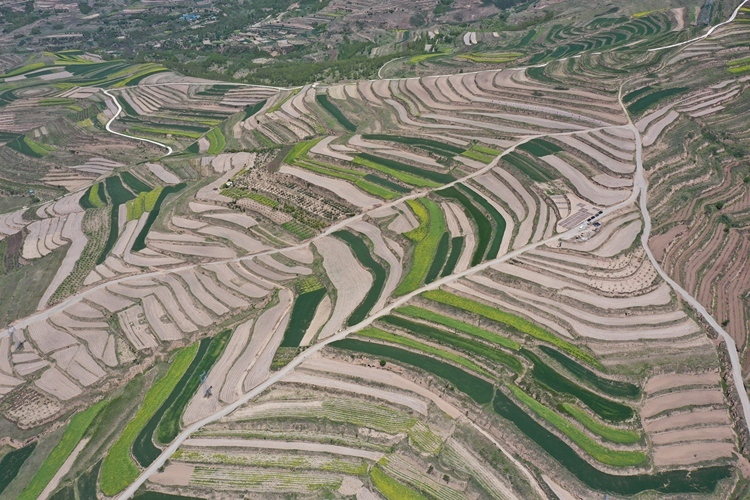
Aerial photo taken on May 11, 2022 shows a view of reclaimed farmland in Qinzhou District of Tianshui, northwest China’s Gansu Province. (Xinhua/Du Zheyu)
<関連情報>
- https://english.cas.cn/newsroom/cas-in-media/202604/t20260413_1156036.shtml
- https://link.springer.com/article/10.1007/s11104-025-08123-w
- https://www.sciencedirect.com/science/article/abs/pii/S0167880924003955
砂漠農業生態系における長期耕作が地表節足動物の多様性とネットワークの安定性に及ぼす影響 Effect of long-term cultivation on ground arthropod diversity and network stability in desert agricultural ecosystems
Yongzhen Wang,Yilin Feng,Jialong Ren,Zhibin He,Jiliang Liu,Wenzhi Zhao & Rong Yang
Plant and Soil Published:02 December 2025
DOI:https://doi.org/10.1007/s11104-025-08123-w
Abstract
Background
The conversion of arid desert landscapes into oasis farmlands significantly alters the diversity of arthropods across different trophic levels, reshaping the structure and function of soil food webs and subsequently affecting the complexity and stability of biotic networks.
Methods
In this study, conducted in the Zhangye Oasis of Northwest China, we systematically investigated changes in ground arthropod communities using pitfall trapping across natural desert and farmlands with varying cultivation years (10-, 30-, 50-, and 100-years).
Results
The results revealed that: (1) The activity density and species richness of ground arthropods exhibited stage responses to cultivation years, with significantly higher activity densities observed in natural desert and 50-year-old farmlands compared to other farmlands; (2) Cultivation promoted the activity of Arachnids, predatory, and herbivorous beetles, while significantly reducing the activity density of omnivorous beetles, which remained highest in natural desert habitats; (3) The 100-year farmland exhibited the highest network complexity, consisting of 28 nodes and 51 edges, yet demonstrated the lowest network stability; (4) Canonical Correspondence Analysis (CCA) showed that soil water content (SWC), electrical conductivity (EC), ammonium nitrogen (NH₄⁺–N), nitrate nitrogen (NO₃⁻–N), and available phosphorus (AP) collectively explained 32.5% of the variation in the ground arthropod community. Among these, NH₄⁺–N (R2 = 0.74), AP (R2 = 0.34), and NO₃⁻–N (R2 = 0.04) were key driving factors, with omnivorous beetles and Arachnids being the most sensitive to environmental changes.
Conclusions
Overall, while cultivation in oasis farmlands enhances the abundance of predatory arthropods and the complexity of soil biotic networks, long-term cultivation may compromise the stability of ground arthropod communities.
耕作年代の異なるオアシスにおける土壌大型動物の栄養構造と土壌要因との関係 Soil macrofauna trophic structure and its relationship with soil factors in oases of contrasting cultivation ages
Yongzhen Wang, Jialong Ren, Wenzhi Zhao, Zhibin He, Longfei Chen, Wei Ren, Jiliang Liu
Agriculture, Ecosystems & Environment Available online: 31 August 2024
DOI:https://doi.org/10.1016/j.agee.2024.109277
Highlights
- The density and taxon richness of soil macrofauna in cultivated croplands were higher than in abandoned croplands.
- The ratio of predatory to phytophagous soil macrofauna in abandoned croplands is lower than that in the cultivated farmlands.
- Soil environmental factors have little effect on predatory soil macrofaunal communities but significantly influence the phytophagy and other feeding types.
Abstract
Transforming arid and semi-arid deserts into farmlands significantly alters soil moisture and fertility, affecting the trophic structure and functionality of soil fauna. Diversity and function of soil macrofaunal community can accurately reflect changes in soil quality and health during the succession of oasis farmlands. In this study, the assemblage of soil macrofauna and soil environmental factors in cultivated and abandoned croplands in the Zhangye Oasis of Gansu Province, were investigated using a hand-sorting method, and we analyzed the relationship between the trophic structure of soil macrofauna and the soil environment. Our results showed that: 1) Farmland cultivation increased the soil water content, soil organic carbon (SOC), total nitrogen (TN), and total phosphorus (TP), while reducing pH. 2) The density, taxon richness, and Shannon-Wiener index of soil macrofauna in cultivated croplands were higher than in abandoned croplands, increasing with cultivation duration. The density of soil macrofauna in 100-year-old farmlands was 2.5, 1.5 and 1.4 times of that in 10-year-old, 30-year-old and 50-year-old farmlands; 3) the density and taxon richness of predatory, phytophagous, and other feeding types of soil macrofauna in cultivated croplands were higher than those of abandoned croplands. The observed increases in density and taxon richness are likely due to the improved soil conditions resulting from cultivation practices. The density-based ratio of predatory to phytophagous and other feeding types of soil macrofauna initially increases then decreases, inversely related to cultivation age. 4) changes in soil environment had little effect on the predatory soil macrofaunal community, and the explained variance by SOC, TP, and pH indicates the significant influence of these soil properties on the composition of the phytophagous soil macrofaunal community. SOC, TP, and pH explained 7.3 % of the variation in phytophagous soil macrofaunal community, while TN, TP, and pH explained 15.4 % of the variation in other feeding types of soil macrofauna. In conclusion, our findings highlight the positive impact of oasis farmland cultivation on soil quality and the enhancement of soil macrofauna diversity, which in turn could contribute to the resilience and productivity of these agricultural ecosystems.