2026-04-07 東北大学
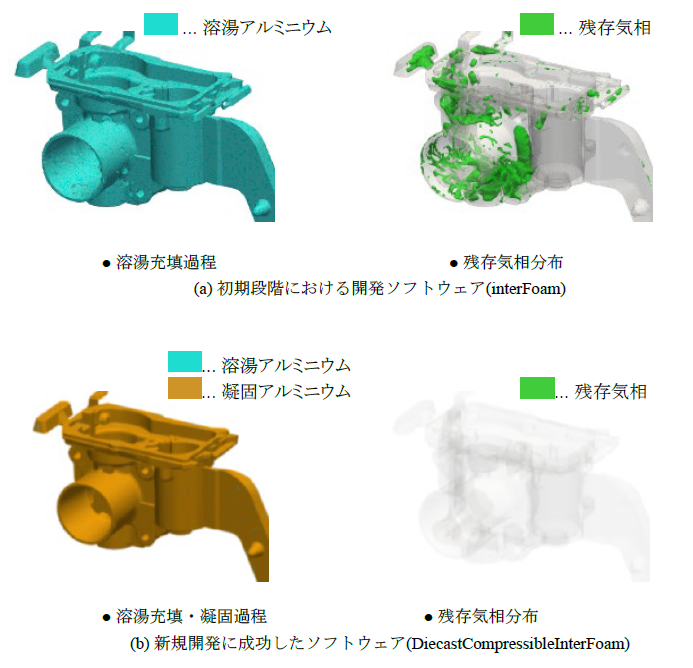
図1. 鋳造解析専用ソフトウェア開発の変遷(溶湯混相流体の圧縮性を考慮し、凝固過程をシミュレート可能なソフトウェア開発に成功した)
<関連情報>
- https://www.tohoku.ac.jp/japanese/2026/04/press20260407-01-Porosity.html
- https://www.tohoku.ac.jp/japanese/newimg/pressimg/tohokuuniv-press20260407_01web_Porosity.pdf
- https://link.springer.com/article/10.1007/s40962-026-01946-y
圧縮性多相高圧ダイカストにおける空気混入と多孔形成の可視化と検証 Visualization and Validation of Air Entrapment and Porosity Formation in Compressible Multiphase High-Pressure Die Casting
Hideaki Yamada,Jun Ishimoto,Fumikazu Sato & Yoshikatsu Nakano
International Journal of Metalcasting Published:23 March 2026
DOI:https://doi.org/10.1007/s40962-026-01946-y
Abstract
This study presents a novel computational solver, DiecastCompressibleInterFoam, for the investigation of air entrapment and porosity formation during high-pressure aluminum die casting, with a focus on visualizing and predicting internal defects that significantly impact product reliability in automotive and precision components. Using the multiphase fluid dynamics framework in OpenFOAM, an open-source fluid analysis software, both compressibility and solidification effects are incorporated in three-dimensional simulations. The solver combines the Volume of Fluid method and Large Eddy Simulations to enable precise analysis of bubble dynamics during turbulent filling and cooling. Polyhedral mesh strategies and mesh optimization improve conformity to complex casting geometries, while real injection waveform data and mapped molten metal temperature distributions ensure realistic boundary conditions. Comparative analysis with X-ray computed tomography data from actual products demonstrates a porosity location agreement rate of up to 60%, confirming the validity of the simulations. Furthermore, optimization of the vent design and outlet boundary conditions effectively reduces air entrapment and porosity rates. Regarding computational efficiency, mesh structure refinement, symmetry modeling, and split analysis for sleeve components are employed, reducing the computation time by up to 55% for the optimized case, compared with the baseline configuration based on the full domain. The proposed modeling approach significantly improves defect prediction accuracy, enabling valuable process feedback and supporting quality assurance in die-cast aluminum components.