
2026-04-02 中国科学院(CAS)
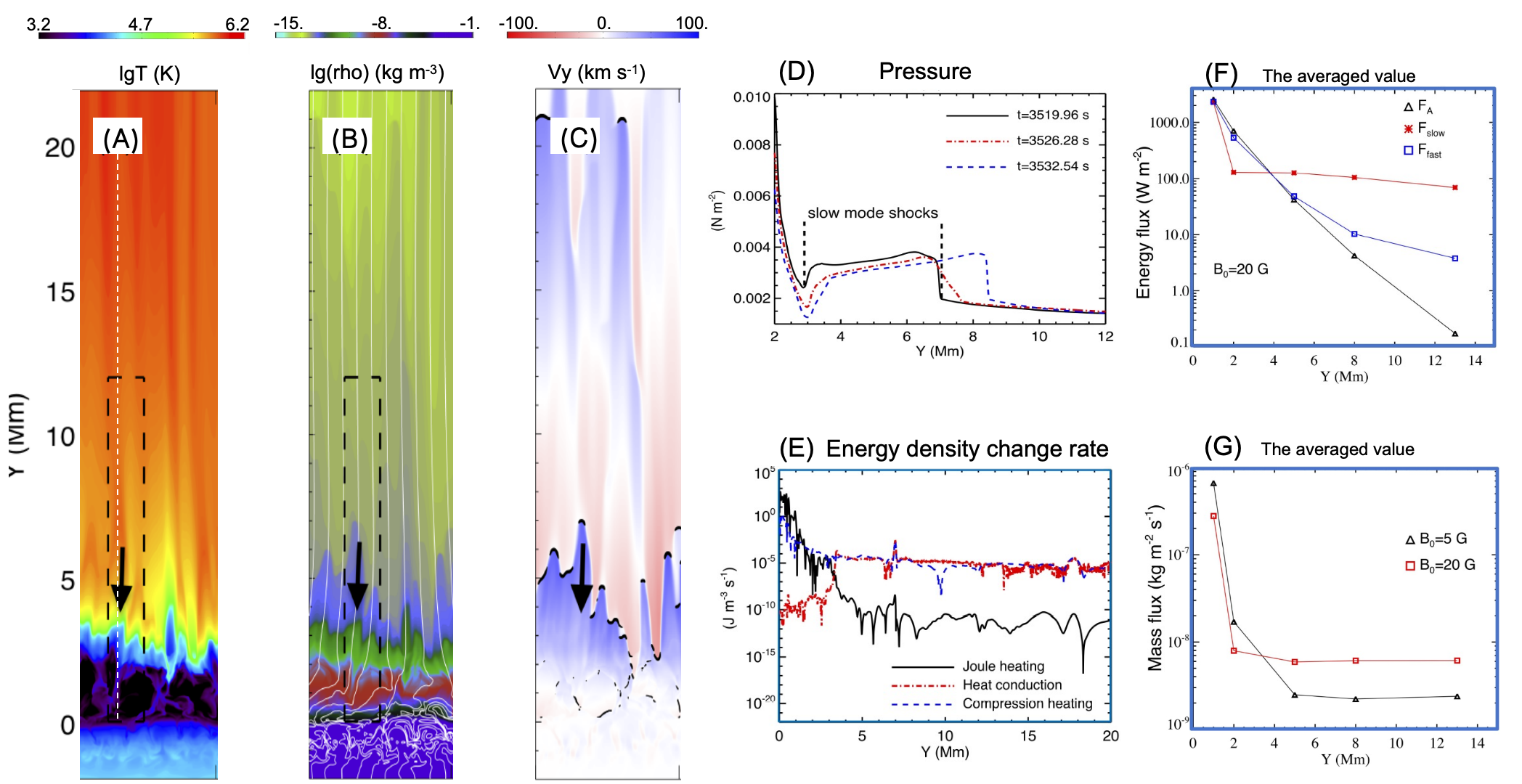
Numerical simulation results of solar spicules. (Image by NI Lei)
<関連情報>
- https://english.cas.cn/newsroom/research-news/202604/t20260402_1155063.shtml
- https://iopscience.iop.org/article/10.3847/2041-8213/ae4964
太陽コロナホールにおける突発的なスピキュラー流に伴うエネルギーおよび物質輸送 Energy and Mass Transport Associated with Impulsive Spicular Flows in Solar Coronal Holes
Lei Ni, Jun Lin, Tanmoy Samanta, Guanchong Cheng, Yifu Wang, and Robert Erdélyi
The Astrophysical Journal Letters Published: 2026 March 17
DOI:10.3847/2041-8213/ae4964
Abstract
How the solar atmosphere is heated from a temperature of about 5000 to 6000 K in the lower atmosphere to about 1–2 MK in the corona has challenged the astrophysical community for nearly 80 yr. The same puzzle exists for the stellar coronae heating as well. In this study, we present a series of findings on solar spicules and their subsequent impact on the corona within a coronal hole environment, characterized by locally open magnetic field lines, combining insights from MHD simulations with observations. We find that the convective and turbulent motions around the solar surface cause extensive shocks and small-scale magnetic reconnection in the lower atmosphere. The combined effects of shock compression and reconnection outflows then drive the formation of groups of spicules with a quasiperiod of about 300 s and a width of ∼200–500 km. The spicule upflows provide an averaged mass flux above 10−9 kg m−2 s−1 in the lower corona to sustain the solar wind in coronal holes, and they continuously trigger further new local slow-mode waves and shocks. These waves supply an energy flux of 10–100 W m−2 in the lower corona, and they are dissipated by heat conduction and compression heating to sustain the corona temperature of about 1 MK. The results also indicate that the upward propagating disturbances observed in extreme ultraviolet passbands are caused by both spicule upflows and slow-mode waves and shocks. Our findings help in understanding the long-standing problem of coronal heating and the origin of solar winds in coronal hole regions.

