20206-03-30 シンガポール国立大学(NUS)
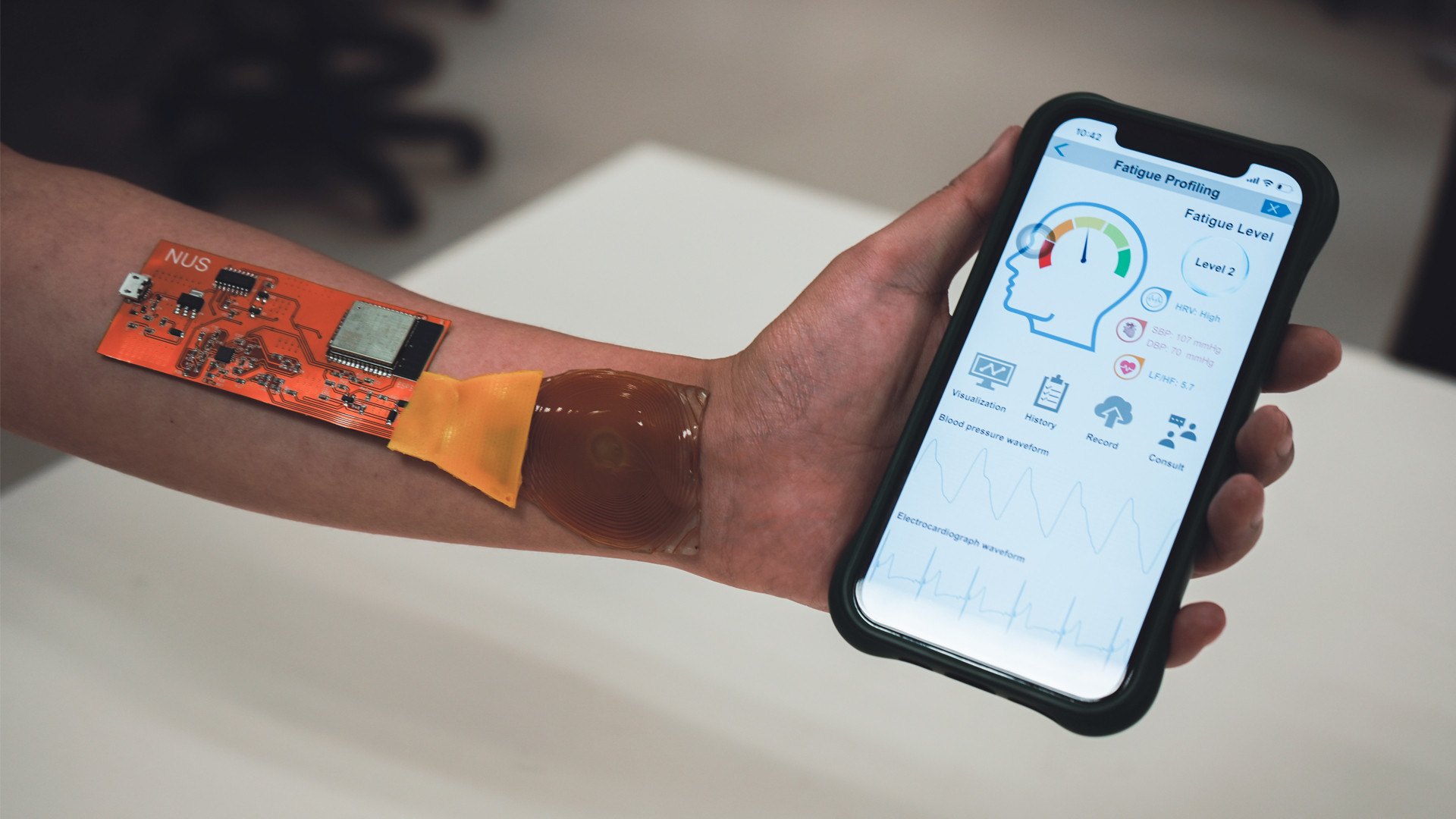
Powered by artificial intelligence, the soft and skin-like hydrogel sensor demonstrates superior performance, especially during movement, when reducing signal noise is critical.
<関連情報>
- https://news.nus.edu.sg/smart-sensor-decodes-fatigue-and-stress-from-body-signals-on-the-move/
- https://www.nature.com/articles/s44460-026-00055-x
メタトポロジーハイドロゲルは、バイオエレクトロニクスにおけるマルチソースおよび周波数調整可能なアーティファクト軽減を可能にする Meta-topological hydrogel enables multisource and frequency-tailored artefact mitigation for bioelectronics
Guo Tian,Longchao Huang,Xinglong Pan,Zhiwei Li,Wanheng Lu,Wei Li Ong,Chang Liu,Yi Zhou,Yue Sun,Weili Deng,Weiqing Yang,Wei Gao & Ghim Wei Ho
Nature Sensors Published:24 March 2026
DOI:https://doi.org/10.1038/s44460-026-00055-x
Abstract
High-fidelity signal acquisition underpins next-generation healthcare bioelectronics, yet motion artefacts severely impair both signal integrity and measurement reliability. Existing mitigation strategies primarily target a single artefact type or a fixed frequency range, limiting scalability and generality. Here we report a meta-topological hydrogel that combines programmable phononic metastructure filtering with topology-tunable ion diffusion to suppress multisource mechanical and biopotential artefacts across tailored frequency ranges. This artefact-mitigating platform enables simultaneous, artefact-free acquisition of haemodynamic and electrophysiological signals, achieving ISO-grade A blood pressure accuracy and an electrocardiograph signal-to-noise ratio of 37.36 dB during daily activities. The platform supports robust feature extraction from physiological signals for fatigue profiling, achieving a deep learning classification accuracy of 92.04%. We further demonstrate effective artefact suppression across diverse biosignals modalities, including heart and respiratory sounds, voice, electroencephalogram and electrooculogram, highlighting its potential for scalable and kinematic-tolerant monitoring in motion-intensive scenarios.