2025-07-23 理化学研究所,産業技術総合研究所,東京電機大学
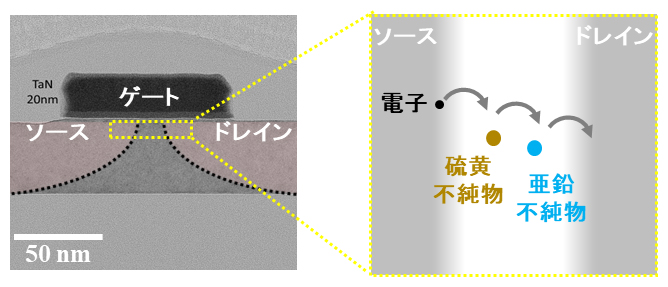
硫黄不純物および亜鉛不純物を添加したトランジスタと不純物を介したトンネル伝導の模式図
<関連情報>
- https://www.riken.jp/press/2025/20250723_2/index.html
- https://www.nature.com/articles/s42005-025-02177-z
シリコン中の個々の深部不純物を通る二重量子ドットトンネル効果における室温でのパウリスピンブロック Pauli spin blockade at room temperature in double-quantum-dot tunneling through individual deep dopants in silicon
Yoshisuke Ban,Kimihiko Kato,Shota Iizuka,Hiroshi Oka,Shigenori Murakami,Koji Ishibashi,Satoshi Moriyama,Takahiro Mori & Keiji Ono
Communications Physics Published:23 July 2025
DOI:https://doi.org/10.1038/s42005-025-02177-z
Abstract
Pauli spin blockade (PSB) is a spin-dependent charge transport process that typically appears in double quantum dot (QD) devices and is employed in fundamental research on single spins in nanostructures to read out semiconductor qubits. The operating temperature of PSB is limited by that of the QDs and remains below 10 K, limiting wide application development. Herein, we confirm that a single deep dopant in the channel of a silicon field effect transistor functions as a room-temperature QD; consequently, transport through two different deep dopants exhibits PSB up to room temperature. The characteristic magnetoconductance provides a means to identify PSB and enables the PSB device to function as a magnetic sensor with a sensitivity below geomagnetic field. Lifting in PSB caused by magnetic resonance (50 K) and Rabi oscillations (10 K) are also observed. Further development of this unique system may lead to room-temperature quantum technologies based on silicon technology.