2026-11-11 イースト・アングリア大学(UEA)
<関連情報>
- https://www.uea.ac.uk/about/news/article/record-breaking-2025-iberian-fire-season-was-three-times-larger-due-to-climate-change
- https://essd.copernicus.org/articles/18/8037/2026/
山火事の現状 2025年~2026年 State of Wildfires 2025–2026
Chantelle A. Burton, Francesca Di Giuseppe, Matthew W. Jones, Douglas I. Kelley, Maria L. F. Barbosa, Joe McNorton, Bob Potts, Carlota Segura-Garcia, John T. Abatzoglou, Iulian Alin Rosu, Niels Andela, Liana O. Anderson, Sally Archibald, Esther Brambleby, Emilio Chuvieco, Andrew Ciavarella, Hamish Clarke, Francisco de la Barrera, Carlos M. Di Bella, Enza Di Tomaso, Kebonye Dintwe, Tim S. Doherty, Victoria M. Donovan, Jonathan M. Eden, Paulo M. Fernandes, Lukas Fiedler, Louis Giglio, Olivia Haas, Douglas S. Hamilton, Stijn Hantson, Sarah Harris, Andrew J. Hartley, Theo Keeping, Crystal A. Kolden, Jean-Luc Kouassi, Elena Kukavskaya, Seppe Lampe, Zhongwei Liu, Guilherme Mataveli, Sarah Meier, Duarte Oom, Mark Parrington, Yuquan Qu, Victor Resco de Dios, Julien Ruffault, Mojtaba Sadegh, Cristina Santín, Fernando Sedano, Jacquelyn K. Shuman, Patrícia S. Silva, Fiona R. Spuler, Carmen B. Steinmann, Veerachai Tanpipat, Miguel Ángel Torres-Vazquez, Marco Turco, Guido R. van der Werf, Dave van Wees, Sander Veraverbeke, Jakob B. Wessel, and Bo Zheng
Earth System Science Data Published:11 Nov 2026
DOI:https://doi.org/10.5194/essd-18-8037-2026
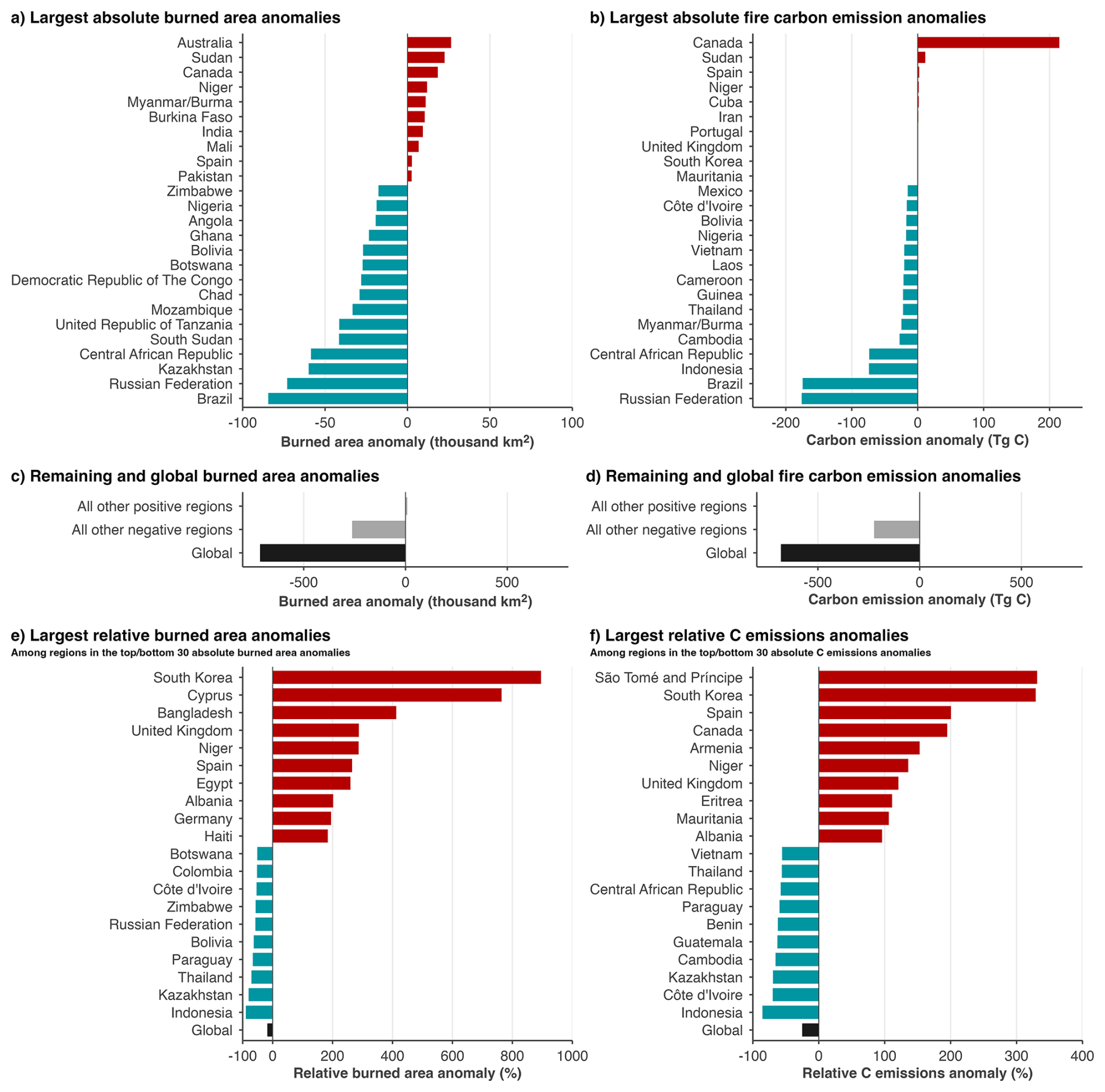
Figure 1Anomalies in BA (BA) and fire carbon (C) emissions at national and global scales. Absolute anomalies in (a) BA and (b) fire carbon emissions are shown for the countries with the largest positive and negative anomalies during the 2025–2026 global fire season, defined as March 2025 to February 2026, relative to the average of prior fire seasons since 2002. Panels (c) and (d) show the combined anomalies for all other positive countries, all other negative countries, and the global total, respectively, using the same anomaly definitions. Relative anomalies in (e) BA and (f) fire carbon emissions are shown for the countries with the largest positive and negative percentage anomalies among those ranking in the top 30 positive or top 30 negative countries by absolute anomaly. BA anomalies are derived from the MODIS MCD64A1 BA product and are reported in thousand km2. Absolute fire carbon emission anomalies are derived from GFED5.1 and are reported in Teragrams of Carbon (TgC), while relative fire carbon emission anomalies use our synthesis value (see Sect. “Calculating Regional Anomalies in Fire Observations”). Countries are excluded from the fire carbon emissions rankings in cases where the sign of the relative carbon emission anomaly differs between GFED5.1 and CAMS GFAS, reflecting our low confidence in the sign of the anomaly.
Tii-summary
English
This report examines global wildfire activity and its relationship with climate change, focusing on major fire events from 2025 to early 2026. It integrates satellite observations, fire statistics, meteorological data, climate attribution analyses, and future projections. Three major regions are investigated: the Midwestern Canadian Shield Forests, Northwest Iberia, and Chilean Temperate Forests and Matorral. The analysis evaluates burned area, fire emissions, and impacts on societies and ecosystems. Although global burned area was 18% below the historical average and fire carbon emissions were 20–31% lower, devastating regional wildfire extremes occurred. Climate change substantially increased the likelihood of these extreme events by intensifying conditions such as heat and dryness. The report warns that without substantial greenhouse gas emission reductions, similar extreme wildfires are likely to become more frequent. This work provides an important scientific basis for understanding regional wildfire extremes, attributing their occurrence to climate change, and improving future wildfire preparedness, adaptation, and mitigation strategies.
出典:Earth System Science Data, 18, 8037–8105 (2026)。出版社の論文本文・抄録および付属データ情報に基づく要約。