2026-11-12 東北大学
東北大学、静岡大学、王子ホールディングス株式会社などの研究グループは、植物由来のセルロースナノファイバーを利用した光応答型の電界効果トランジスタを開発した。研究では、セルロースナノファイバーをリン酸エステル化してアモルファス構造とした材料(APCNF)を用い、金属半導体電界効果トランジスタ(MESFET)を作製した。その結果、従来のセルロースナノファイバーと比較して電気伝導度が約6桁向上し、負のゲート電圧を印加した状態で緑色光(波長490~550nm)を照射すると、電流のオン・オフを切り替えるスイッチング特性が得られた。さらに、電子スピン共鳴法による解析から、電気伝導にヒドロキシルラジカルに由来する不対電子が関与していることを明らかにした。本成果は、豊富な森林資源から得られる再生可能なバイオマス素材に半導体機能を付与するものであり、環境負荷の低い電子デバイスや、光信号と電気信号を融合する光電融合技術への応用が期待される。
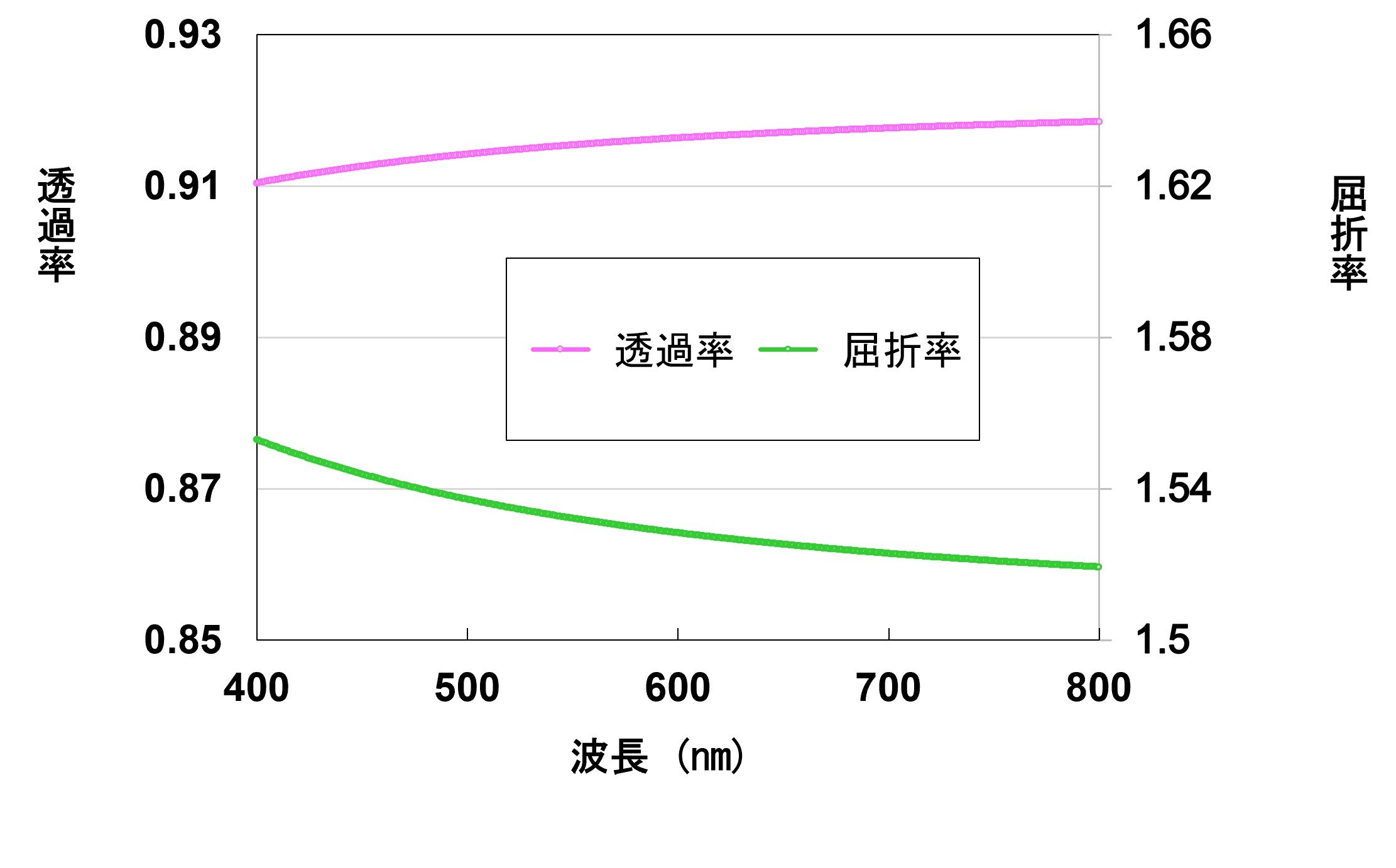
図1. 400nm~800 nmの波長領域における光透過率と屈折率の測定結果。波長が増加するに従って、透過率は0.90から0.92まで上昇する一方、屈折率は1.58 から1.52まで減少した。
<関連情報>
- https://www.tohoku.ac.jp/japanese/2026/11/press20261112-01-nanofibers.html
- https://pubs.aip.org/aip/adv/article/16/11/115008/3407953/Green-light-switching-of-Schottky-gated
リン酸化セルロースナノファイバーを用いたショットキーゲートトランジスタの緑色光スイッチング(Green-light switching of Schottky-gated transistors made from phosphorylated cellulose nanofibers)
Mikio Fukuhara, Tomonori Yokotsuka, Takahito Ono, Koshiro Yaegashi, Masahiko Kumadaki, Nobuhisa Fujima, Kentaro Kishi
AIP Advances 2026-11-03
DOI: 10.1063/5.0353127
Tii-summary
本研究では、リン酸化セルロースナノファイバー(PCNF)を半導体材料として用いたショットキーゲート型金属・半導体電界効果トランジスタ(MESFET)を作製し、光の波長による電気特性の制御を実証した。PCNFは約92%の高い光透過率を持ち、n型半導体として動作する。作製したトランジスタに紫外、青、緑、黄、赤、赤外光を照射した結果、特に490~550 nmの緑色光でドレイン電流が大きく低下し、ゲート電圧による電流増幅が抑制されることを確認した。この緑色光によるスイッチングは、繰り返し照射でも再現された。電子スピン共鳴測定や第一原理計算などから、リン酸基に由来する酸素ラジカルが電子状態に関与する可能性が示された。緑色光照射による電流抑制の詳細な機構には未解明な点が残るものの、植物由来の透明なセルロース材料を光制御型トランジスタに応用できる可能性を示した成果である。
This study demonstrates wavelength-controlled switching in Schottky-gated metal–semiconductor field-effect transistors (MESFETs) fabricated from phosphorylated cellulose nanofibers (PCNFs). The PCNF material exhibits approximately 92% optical transmittance and n-type semiconducting behavior. When the transistors were irradiated with ultraviolet, blue, green, yellow, red, and infrared light, a pronounced reduction in drain current was observed under green light (490–550 nm), suppressing the gate-voltage-induced current amplification. This switching response was reproducible over repeated illumination cycles. Electron spin resonance measurements and first-principles calculations suggested that oxygen radicals associated with phosphate groups may contribute to the electronic properties. Although the detailed mechanism of green-light-induced current suppression remains unresolved, the findings demonstrate the potential of transparent, cellulose-based materials for optically controlled transistor devices.
This study demonstrates wavelength-controlled switching in Schottky-gated metal–semiconductor field-effect transistors (MESFETs) fabricated from phosphorylated cellulose nanofibers (PCNFs). The PCNF material exhibits approximately 92% optical transmittance and n-type semiconducting behavior. When the transistors were irradiated with ultraviolet, blue, green, yellow, red, and infrared light, a pronounced reduction in drain current was observed under green light (490–550 nm), suppressing the gate-voltage-induced current amplification. This switching response was reproducible over repeated illumination cycles. Electron spin resonance measurements and first-principles calculations suggested that oxygen radicals associated with phosphate groups may contribute to the electronic properties. Although the detailed mechanism of green-light-induced current suppression remains unresolved, the findings demonstrate the potential of transparent, cellulose-based materials for optically controlled transistor devices.
原著論文:AIP Advances