2026-10-20 北海道大学
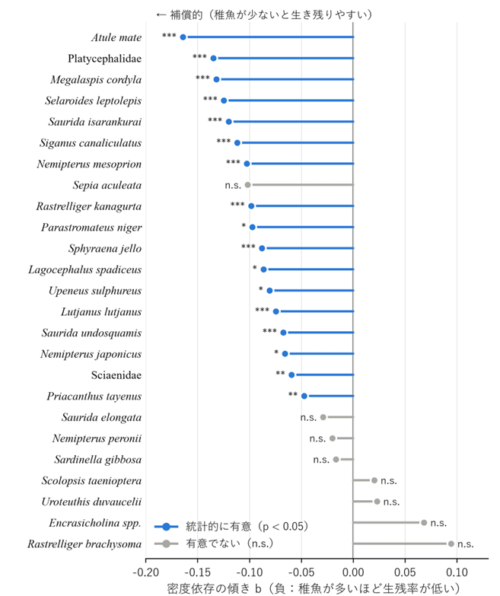
図1. 底びき網漁獲量上位25分類群の稚⿂期における密度依存の傾き。負の値は、稚⿂が多いほど翌⽉までの⽣残率が低い(補償的な密度依存)ことを⽰す。⻘:統計的に有意、灰:有意でない。***:p < 0.001、**:p < 0.01、*:p < 0.05、n.s.:有意でない。(論⽂Table 2 をもとに作図)
<関連情報>
- https://www.hokudai.ac.jp/news/2026/10/post-2473.html
- https://www.hokudai.ac.jp/news/pdf/261020_pr3.pdf
- https://link.springer.com/article/10.1007/s12562-026-02025-1
タイ湾における稚魚期の密度依存死亡 Early-life density-dependent mortality in the Gulf of Thailand
Jeeratorn Yuttharax, Pavarot Noranarttragoon, Changoma Marko Fransis, Methee Kaewnern & Takashi Fritz Matsuishi
Fisheries Science Published:18 September 2026
DOI:https://doi.org/10.1007/s12562-026-02025-1
Abstract
Density-dependent mortality is a key mechanism regulating fish population dynamics, yet empirical evidence from tropical systems remains limited. This study investigated density-dependent survival during early life of 25 dominant taxa from trawl landings in the Gulf of Thailand, where trash fish (TF) catches include many juveniles. Temporal variation in the abundance of fish at ages smaller than was linked to subsequent survival to evaluate compensatory density dependence. Growth analyses revealed interspecific variation, with asymptotic length () ranging from 8.0 to 55.2 cm and growth coefficients () from 0.134 to 1.356 year−1. Overall, 21 taxa exhibited negative density-dependent slopes, including 17 statistically significant relationships, of which 11 showed strong support (p < 0.001), including Rastrelliger kanagurta, Atule mate, and Lutjanus lutjanus. In contrast, only 4 taxa exhibited positive slopes, and none were statistically significant. These results indicate compensatory density-dependent mortality is widespread across TF taxa, although its strength varies among species. By increasing survival among juveniles when abundance is reduced, compensatory mortality can partially offset losses before recruitment, helping explain why juvenile removal through TF catches does not necessarily translate into proportional declines in long-term productivity. Incorporating density-dependent processes into assessment frameworks could improve biological realism in tropical fisheries management.