2026-09-21 中国科学院(CAS)
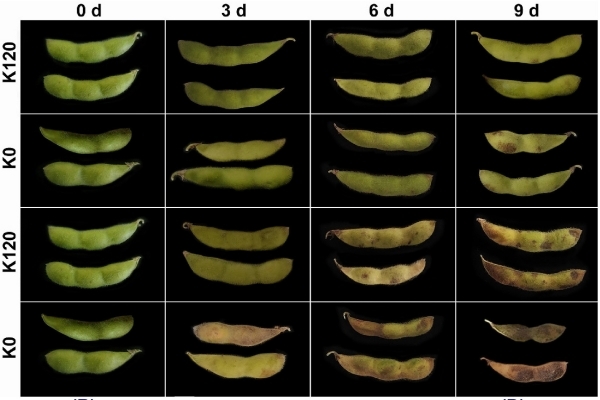
Appearance changes of vegetable soybean pods under different potassium and temperature treatments during nine days of storage. (Image by LIU Changkai)
<関連情報>
- https://english.cas.cn/newsroom/research-news/202609/t20260921_1201046.shtml
- https://www.sciencedirect.com/science/article/pii/S0963996926022581
収穫前のカリウム施用と収穫後の低温貯蔵は、脂質酸化とジャスモン酸シグナル伝達を抑制することにより、野菜大豆の保存期間を延長する Pre-harvest potassium and postharvest cold storage extend vegetable soybean shelf life by inhibiting lipid oxidation and Jasmonate signaling
Changkai Liu, Qiuying Zhang, Bingjie Tu, Yanfeng Hu, Zhenhua Yu, Yansheng Li, Xiaobing Liu
Food Research International Available online: 30 August 2026
DOI:https://doi.org/10.1016/j.foodres.2026.120571
Highlights
- Potassium and low temperature reduce fresh weight loss rate in vegetable soybean from 67% to 11% after 9 days.
- Combined treatment suppresses LOX activity and delays polyunsaturated fatty acid oxidation.
- Multi-omics analysis reveals that the treatment inhibits jasmonic acid biosynthesis and signaling.
Abstract
Postharvest dehydration and senescence limit the shelf life of vegetable soybean. This study investigated the effects of pre-harvest potassium (K) fertilization and postharvest low-temperature storage on quality preservation, using physiological assays, widely targeted metabolomics, and transcriptomics in pods produced under K-deficient (K0) and K-sufficient (K120) conditions and stored at 4 °C or 25 °C. K120 seeds contained significantly higher K than K0 seeds (15.0 vs. 12.0 mg g−1 DW), confirming differential nutritional status. After 9 days of storage, low temperature combined with optimal K nutrition markedly reduced the fresh weight loss rate to 11.3%, compared to 66.5% under ambient temperature without K fertilization. This preservation was associated with suppressed lipoxygenase (LOX) activity, polyunsaturated fatty acid (PUFA) oxidation, and downregulation of α-linolenic acid metabolism and subsequent downregulation of JA biosynthesis. Metabolomic analysis further revealed co-enrichment of flavonoid and phenylpropanoid pathways, suggesting co-regulation of antioxidant defense with JA-driven senescence. Exogenous methyl jasmonate treatment increased endogenous JA levels and accelerated physiological maturation and senescence, confirming the promotive role of JA signaling; JA-mediated responses were closely linked with ethylene and abscisic acid (ABA) pathways. These results suggest that potassium nutrition and cold storage extend vegetable soybean shelf life by inhibiting LOX-mediated PUFA oxidation and JA-driven senescence signaling, within a broader metabolic network encompassing antioxidant defense and energy metabolism.