2026-09-01 東京科学大学
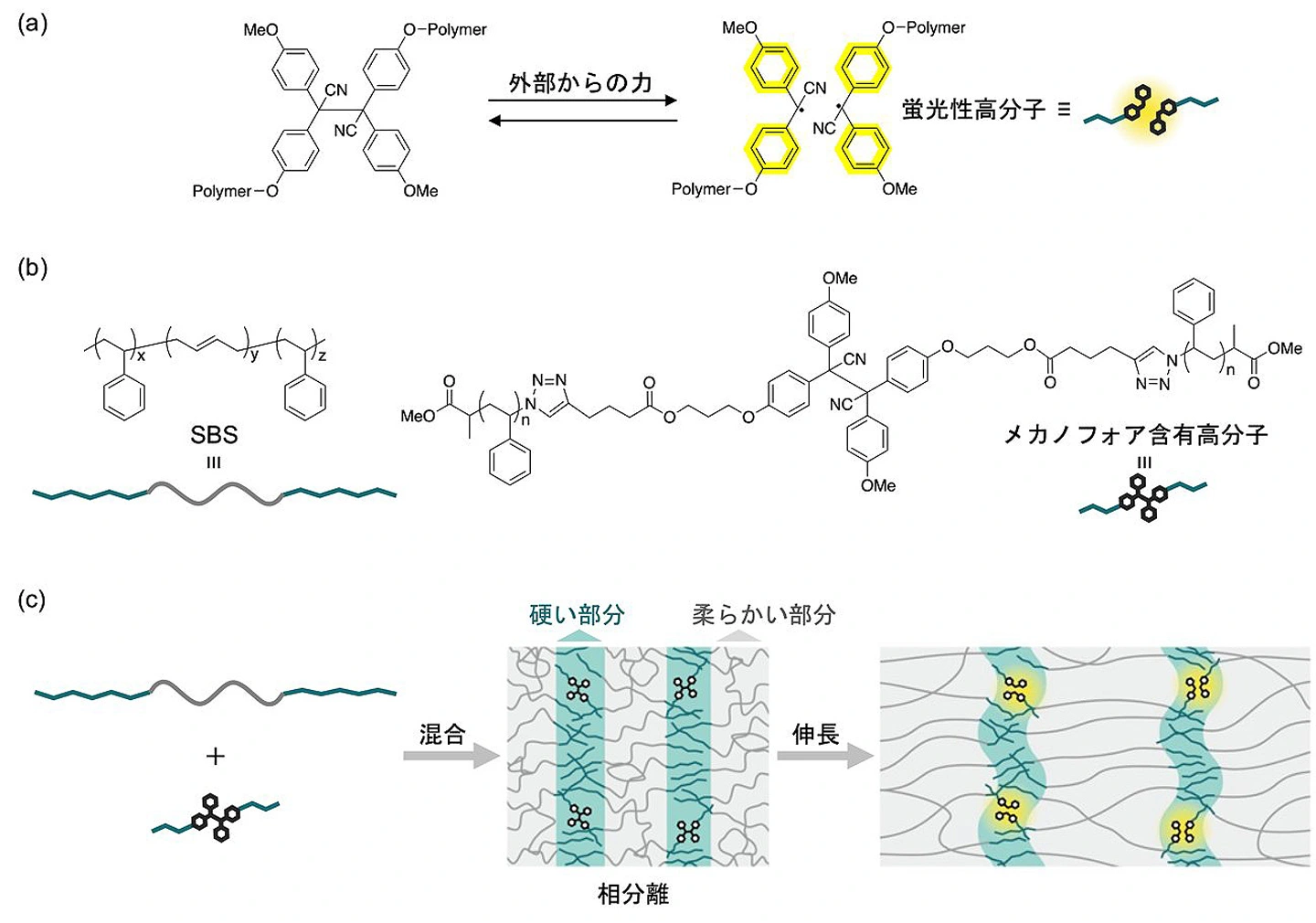
図1. 本研究の概要。
<関連情報>
- https://www.isct.ac.jp/ja/news/ivaybgkpijsa
- https://advanced.onlinelibrary.wiley.com/doi/10.1002/adma.74610
マイクロ相分離構造内における応力伝達:ブロック共重合体材料に機械的応答性を付与するための合成後戦略 Stress Transfer Within Microphase-Separated Structures: A Post-Synthetic Strategy to Impart Mechanoresponsiveness to Block Copolymer Materials
Kuniaki Ishizuki, Akira Kodaka, Akira Takahashi, Hideyuki Otsuka
Advanced Materials Published: 17 August 2026
DOI:https://doi.org/10.1002/adma.74610
ABSTRACT
Mechanoresponsive polymers, which exhibit changes in properties such as color in response to mechanical stimuli, have attracted increasing attention for smart materials. Among various design strategies, mechanophore-incorporated systems are widely used approaches that enable precise molecular-level design and control; however, this approach often suffers from complicated synthesis and limited applicability to existing materials such as block copolymers, which have found widespread industrial use as high-performance materials. Here, we present a post-synthetic strategy enabled by exploiting microphase-separated structures to impart mechanochromism to existing polymer systems while retaining the advantages of mechanophore-based approaches. By exploiting the microphase-separated structure of styrene–butadiene–styrene (SBS) block copolymers, blending with polystyrene bearing a tetraarylsuccinonitrile (TASN) mechanophore enables domain-selective localization of the mechanophore within the rigid domains without chemical modification of the host polymer. The resulting materials exhibit fluorescence upon tensile deformation originating from force-induced TASN cleavage, demonstrating mechanoactivation even under minimal deformation of the hard domains. The mechanoresponse is governed by the molecular weight and content of the mechanophore-containing polystyrene. Importantly, bulk mechanical properties are preserved and can even be enhanced. This strategy establishes a scalable platform for integrating mechanochemical functionality into existing polymer systems.