2026-08-04 東北大学
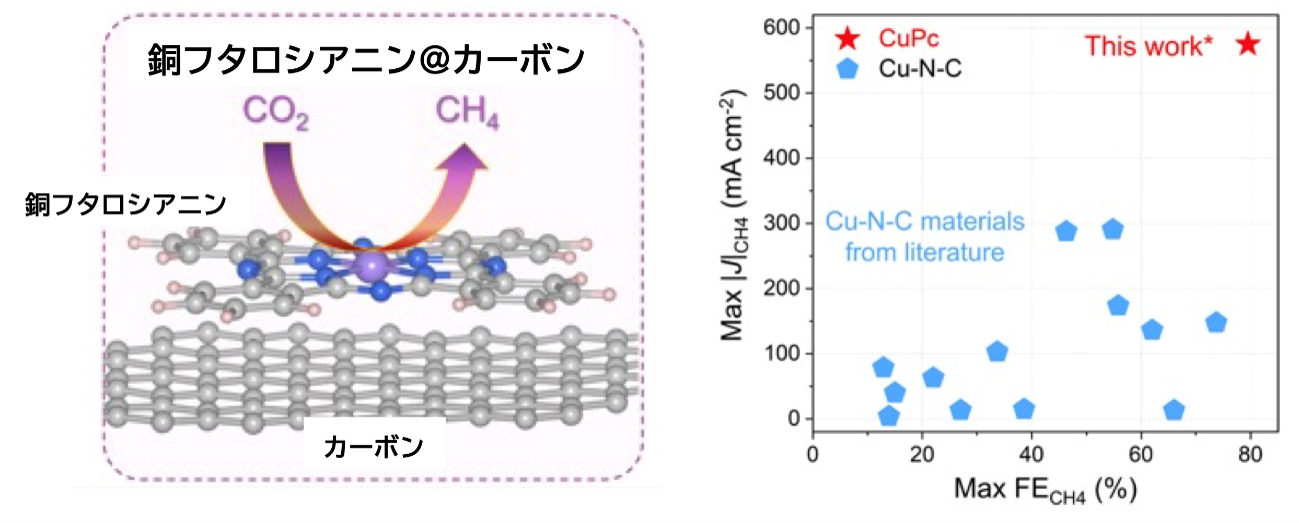
図1. 銅フタロシアニンを担持したカーボンの模式図(左図)とCO2→CH4変換の触媒性能(右図、最大電流密度と最大ファラデー効率)。
<関連情報>
- https://www.tohoku.ac.jp/japanese/2026/08/press20260804-03-co2.html
- https://onlinelibrary.wiley.com/doi/full/10.1002/smll.75041
電気触媒的CO₂メタン化におけるCu–N–C分子触媒の構造依存的性能の解明 Unraveling Structure-Dependent Performance of Cu–N–C Molecular Catalysts for Electrocatalytic CO2 Methanation
Tengyi Liu, Xiaofan Hou, Songbo Ye, Kosuke Ishibashi, Yutaro Hirai, Yasutaka Matsuo, Shimpei Ono, Hao Li, Hiroshi Yabu
Small Published: 02 August 2026
DOI:https://doi.org/10.1002/smll.75041
ABSTRACT
High-rate CH4 electrosynthesis offers a promising strategy for converting CO2 into energy-dense fuels compatible with existing natural gas infrastructure. Cu–N–C molecular catalysts with well-defined Cu–N4 sites show strong potential for CO2-to-CH4 production, yet the role of the macrocyclic backbone remains unclear. Herein, we compare two representative Cu–N–C molecular catalysts, copper phthalocyanine (CuPc) and copper tetraphenylporphyrin (CuPr), to clarify how the macrocyclic backbone influences CO2-to-CH4 electrocatalysis. When supported on conductive carbon and integrated into gas-diffusion electrodes, CuPc markedly outperforms CuPr, achieving a CH4 Faradaic efficiency of 79.5%, a high partial current density of −575 mA cm−2, a mass activity of 19 166.7 A g−1, and stable operation for over 80 h at −150 mA cm−2. Characterization results suggest that the Pc-macrocyclic backbone modulates the electronic structure of the Cu center and interfacial charge-transfer behavior, possibly through its extended π-conjugated Pc-ring and bridge-N environment. Theoretical calculations reveal a favorable CH4-forming pathway on the CuPc/C model, with a lower free-energy barrier for the potential-determining step than that reported for CuPr, suggesting facilitated CH4 formation. These findings indicate that the macrocyclic backbone can regulate reaction pathways and intermediate adsorption energetics, providing mechanistic insight and design guidance for molecular catalysts for CO2-to-CH4 electroreduction.